



Canada is once again reshaping its immigration strategy, and the latest update on the Canada TR to PR pathway has captured attention across the country. With millions of temporary residents already living, working, and contributing to the economy, this pathway is expected to play a major role in shaping the future of permanent residency.
For those wondering what TR to PR pathway Canada is, it is essentially a transition route that allows temporary residents to become permanent residents based on their work and integration.
In a recent statement, Canada’s Immigration Minister Lena Metlege Diab confirmed that Canada plans to allocate 33,000 permanent residency spots under the new TR to PR pathway over two years. This is a clear indication that the country is focusing on individuals who are already part of Canadian society. In short, priority is now being given to those who are already integrated into communities, employed, and contributing to the economy. This clearly reflects the direction of Canada TR to PR explained in current immigration strategy.
The Canada TR to PR Pathway and Its Key Aspects
The TR to PR Pathway Canada is designed to transition temporary residents into permanent residents more efficiently. The focus is on individuals who have already spent time in Canada. These are people who have jobs, housing, and established community ties. The idea is simple. These individuals are already contributing. Moving them to permanent residency strengthens both the economy and social stability. This approach also reduces pressure on infrastructure, as these individuals are already settled.
1. Focus on Rural Communities
One of the most important aspects of the new pathway is its geographic focus. The program is expected to prioritize applicants living outside major city centers. Areas such as Toronto, Vancouver, and Montreal may not be included. Instead, the emphasis is on smaller communities and regions that need workforce support. This creates new opportunities for applicants working in less populated areas. For many candidates, location will play a key role in eligibility.
2. Work Experience as a Key Factor
The pathway places strong emphasis on Canadian work experience. Applicants are expected to have close to two years of work experience in Canada. This is higher than many existing programs. This requirement ensures that candidates are well-established in the labour market. It also increases the likelihood of long-term success after obtaining permanent residency. This aligns with evolving TR to PR Canada requirements 2026, where work experience plays a central role.
3. Flexible Approach to Job Sectors
Unlike previous expectations, the pathway may not be limited to specific industries like healthcare or construction. Early insights suggest that general Canadian work experience could be sufficient, rather than strict sector-based selection. This is an important shift. It opens opportunities for workers across various industries, including retail, hospitality, administration, and other roles that are often overlooked in targeted programs. From skilled professionals to service workers, the pathway may be broader than initially expected.
This means the pathway could benefit multiple groups including TR to PR for skilled workers in Canada, TR to PR for healthcare workers in Canada, and even TR to PR for international students Canada
4. The Reality for Temporary Residents
Despite these confirmations, there is still uncertainty. Many key details remain unknown. These include application procedures, language requirements, processing timelines, and whether the program will follow a first-come system. This creates a challenge for applicants who need to prepare in advance. At the same time, there is urgency. Over 300,000 work permits expired in early 2026, and many more are set to expire throughout the year. For these individuals, waiting without preparation is not an option.
TR to PR Pathway Latest Update 2026
The TR to PR Pathway Latest Update 2026 confirms that Canada is not launching a new open application stream as many expected. Instead, the government is accelerating permanent residence processing for temporary workers who already have applications under programs such as the Provincial Nominee Program and Atlantic Immigration Program.
At least 20,000 workers are expected to receive permanent residence this year, with more transitioning in the next phase. This update highlights a shift toward targeted processing rather than broad intake. Temporary residents without active applications should continue focusing on existing pathways like Express Entry and PNP programs, which remain the most reliable options for securing permanent residence in Canada.
Source: TR to PR Pathway Update
Applicants are actively looking for the TR to PR pathway latest update 2026 to better plan their next steps.
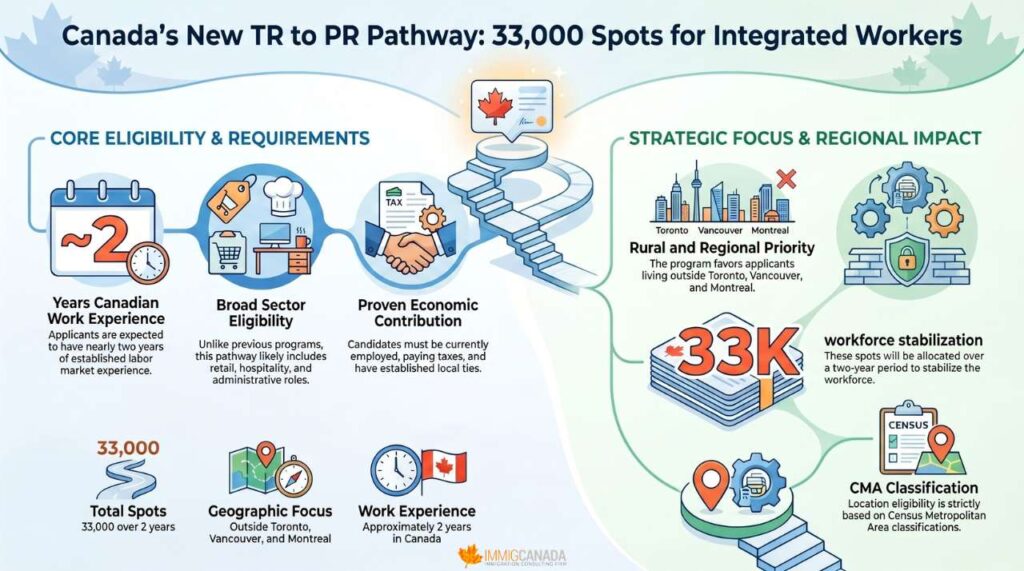
Confirmed Details From Minister’s Statement
While full criteria are still awaited, several important details have already been confirmed about the TR to PR pathway in Canada.
Here is a structured breakdown based on the latest update:
| Detail | What Has Been Confirmed |
| Total Spots | 33,000 permanent residency spaces over 2 years |
| Geographic Focus | Outside major city centres like Toronto, Vancouver, and Montreal |
| Location Criteria | Based on the Census Metropolitan Area classification |
| Work Experience | Around 2 years of Canadian work experience expected |
| Sector Requirement | Not strictly sector specific, broader eligibility likely |
| Community Ties | Applicants must have local connections |
| Housing Factor | Applicants already have housing in Canada |
| Economic Contribution | Must be working and paying taxes |
| Full Criteria Release | Expected very soon |
This table clearly shows that the TR to PR pathway is focused on stability, contribution, and integration rather than just qualifications.
Source: Exclusive sit-down interview with Canada’s Immigration Minister Lena Metlege Diab
What Applicants Should Do Now?
Even though the full criteria are yet to be released, applicants should start preparing.
- Focus on maintaining valid work permits. Ensure that employment records are complete and accurate.
- Language test results should be updated if required. This will be crucial once the language requirement for TR to PR Canada is officially announced.
- Applicants should also explore other pathways such as Express Entry and provincial programs.
The Canada TR to PR pathway is an opportunity, but it is not the only route. ImmigCanada continues to guide applicants through all available options to maximize success. The upcoming TR to PR pathway in Canada highlights a strong shift toward selecting candidates who are already contributing to Canadian society. With 33,000 spots expected, the pathway offers opportunity, but also requires preparation and awareness. Many applicants are closely monitoring whether a new TR to PR Canada announced program will follow similar criteria or expand further.
Frequently Asked Questions about the New TR to PR Pathway
Applicants should be prepared with strong documentation even before the official announcement. This will likely include proof of Canadian work experience, such as pay stubs, T4 slips, and employer reference letters. Identity documents, valid passports, and proof of legal status in Canada will also be essential. Language test results may be required depending on the final criteria. This aligns with common expectations around Canada TR to PR documents required.
This is not officially confirmed, but based on existing immigration programs, part-time work may count if it meets equivalent full-time hours.
The government has not yet confirmed language requirements. However, most permanent residency programs in Canada require proof of English or French proficiency.
Family inclusion has not been confirmed yet. However, in most Canadian immigration programs, spouses and dependent children can be included in the same application. Applicants should be prepared with supporting documents for family members, including passports, medical records, and relationship proof.
The pathway is expected to be highly competitive. With only 33,000 spots available and millions of temporary residents in Canada, demand will likely exceed supply.
Yes, maintaining a valid status is critical. Applicants whose work permits expire may lose eligibility if they do not apply for an extension.
This is currently unclear. Most Canadian immigration programs require employer-based work experience. If the pathway focuses on verifiable employment and tax contributions, self employed individuals may face additional requirements or limitations.
Yes, indirectly. By transitioning temporary residents already in Canada into permanent residents, the government can reduce pressure on new application intake.
Based on past programs, there is a possibility that the intake could reach capacity very quickly. If the program follows a first-come system, applicants who are not prepared may miss the opportunity.
At this stage, it appears to be a limited program with a fixed number of spots over two years. It is not confirmed whether it will become a permanent pathway.
Staying updated and ahead is important and crucial for your Canada immigration journey. Visit ImmigCanada Immigration services to learn more about TR to PR pathways, Canada Immigration Programs, permits, and policies. Connect with ImmigCanada verified consultants to receive expert guidance and take confident steps toward building your future in Canada.