


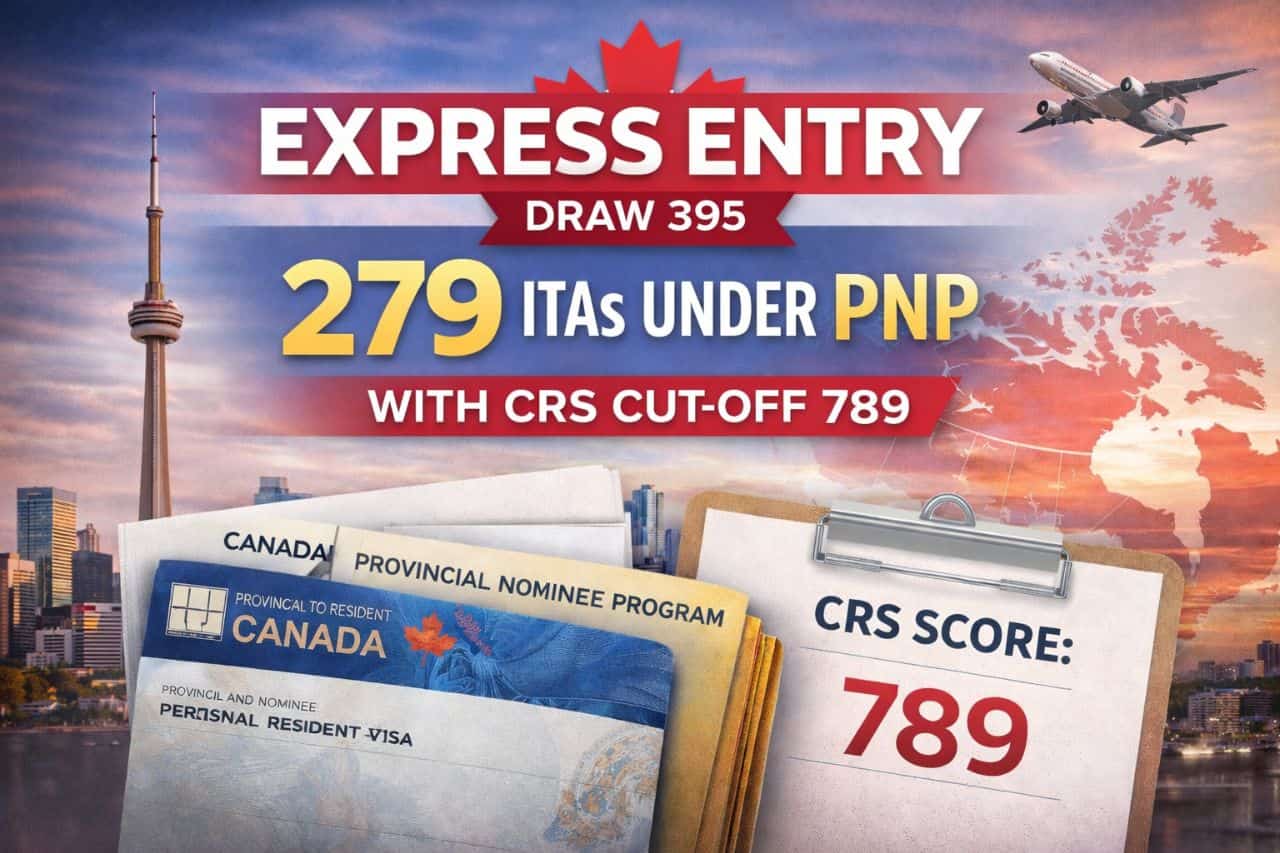
Canada held Express Entry Draw 395 on February 16, 2026, issuing 279 Invitations to Apply (ITAs) to candidates under the Provincial Nominee Program (PNP). The CRS cut-off reached 789, reflecting the high scores typical of PNP-specific draws, where candidates receive an additional 600 CRS points for securing a provincial nomination. This latest round reinforces the growing importance of provincial immigration pathways for candidates seeking Canadian permanent residence in 2026.
Key Details of Express Entry Draw 395
- Draw Number: 395
- Date: February 16, 2026
- Program Targeted: Provincial Nominee Program
- Invitations Issued: 279
- CRS Cut-off Score: 789
- Tie-breaking rule: September 5, 2025
The CRS score increased compared to earlier February draws primarily because fewer invitations were issued. When draw sizes are smaller, competition rises and cut-off scores typically move higher. For candidates with provincial nominations, however, these variations rarely affect eligibility since the nomination already places them among the top-ranked profiles.
Why Provincial Nominations Remain Critical in 2026
Provincial nomination programs continue to be one of the most reliable routes to permanent residence through Express Entry. By adding 600 CRS points, a nomination effectively guarantees strong competitiveness in future invitation rounds.
Candidates can improve their nomination chances by:
- Applying to multiple provincial streams where eligible
- Monitoring occupation-specific draws aligned with labour shortages
- Improving language scores to meet provincial thresholds
- Demonstrating strong settlement intent in the chosen province
- Preparing complete documentation before intake openings
Working with the Best RCIC in Canada helps applicants align their work experience, occupation codes, and settlement strategy with provincial priorities, significantly improving nomination success rates.
CRS Pool Trends and Future Draw Expectations
Recent pool data shows continued competition in the 501-600 CRS range, indicating that many candidates are actively strengthening their profiles through language retests, education upgrades, and nomination strategies. Immigration experts anticipate additional category-based draws, including Canadian Experience Class invitations, which may feature lower CRS thresholds than PNP-specific rounds.
Applicants awaiting invitations should ensure their Express Entry profiles remain updated and accurate. Even minor inconsistencies in employment history or documentation can affect nomination eligibility or final application approval.
Through ImmigCanada immigration consulting services, applicants receive personalized guidance on optimizing their CRS score, preparing provincial nomination applications, and managing Express Entry timelines effectively.
At ImmigCanada immigration consulting services, our team, including Eivy Joy Quito, a Regulated Immigration Consultant and certified Canadian immigration consultant, continues to assist applicants in identifying the most effective provincial strategies to secure nominations and improve their Express Entry ranking.
Express Entry Draw 395, which issued 279 ITAs with a CRS cut-off of 789, highlights the continued priority given to provincial nominees in Canada’s immigration strategy. For candidates aiming to secure permanent residence in 2026, focusing on provincial nomination opportunities remains one of the most effective approaches. Consulting a Regulated Immigration Consultant such as Eivy Joy Quito ensures that applicants develop strong nomination strategies, maintain accurate profiles, and maximize their chances of receiving an invitation in upcoming draws.
Frequently Asked Questions About Express Entry Draws in 2026
Comprehensive Ranking System (CRS) cut-off scores in Express Entry draws fluctuate based on immigration targets, draw size, and category-based selection priorities. While general draws in recent years have often exceeded 500 CRS points, category-based draws targeting occupations such as healthcare, STEM, trades, or French-language proficiency have issued invitations at significantly lower CRS thresholds, sometimes below 490. Whether scores fall to 490 depends primarily on draw volume and the balance between candidates entering the pool and invitations issued. Canada’s multi-year immigration levels plan continues to prioritize economic immigration, meaning larger draws or expanded category-based rounds can reduce CRS cut-offs. However, competition in the Express Entry pool remains high, so sustained CRS levels below 490 in general draws are uncertain without increased invitation numbers.
The Temporary Resident to Permanent Resident (TR to PR) pathway introduced in 2021 was a one-time public policy created to transition essential workers and international graduates already in Canada to permanent residence during pandemic travel restrictions. Since then, Canada has shifted back to regular immigration programs, primarily Express Entry and Provincial Nominee Programs (PNPs). As of 2026, there has been no official announcement confirming a reopening of TR to PR–style pathways. However, Canada has expanded category-based Express Entry draws and targeted provincial streams that effectively provide similar transitions for workers already in Canada. Future TR to PR programs would likely depend on labour shortages or policy priorities rather than becoming a permanent immigration stream.
A CRS score of 450 is currently below the threshold for most general Express Entry draws, which in recent years have typically exceeded 500. However, 450 can still be competitive in category-based draws targeting specific occupations or French-language proficiency, where CRS cut-offs have historically been lower than general rounds. Candidates with 450 CRS may also improve their chances through provincial nomination, which adds 600 CRS points and guarantees an invitation to apply (ITA). Improving language scores, gaining additional work experience, or securing arranged employment can also increase CRS. While 450 alone may not be sufficient for general draws, targeted selection categories and provincial pathways still make permanent residence possible at this level.
Yes. Canada continues to grant permanent residence through Express Entry, Provincial Nominee Programs, family sponsorship, and other economic pathways in 2025–2026. The federal immigration levels plan maintains high targets for economic immigration, with Express Entry remaining the primary federal selection system for skilled workers. Draws have continued regularly, including both general and category-based invitations aligned with labour market needs. While processing priorities and selection categories evolve, Canada’s long-term demographic and economic strategy still depends on immigration growth. As a result, permanent residence opportunities remain widely available through established programs rather than temporary public policies.
There is no confirmed policy indicating the return of the TR to PR pathway as of 2026. Canada has instead integrated transition opportunities into existing immigration systems, particularly Express Entry category-based draws and employer-driven Provincial Nominee Programs. These mechanisms allow temporary workers and graduates already in Canada to obtain permanent residence without creating a separate TR to PR stream. Immigration policy trends suggest Canada prefers targeted, occupation-based selection rather than broad one-time transition programs. Any future TR to PR-type initiative would likely be temporary and tied to specific labour shortages rather than a permanent program.
Canadian permanent resident (PR) status itself does not expire after a fixed period such as 5 or 10 years. Once granted, PR status remains indefinitely as long as residency obligations are met, specifically, living in Canada for at least 730 days within a 5-year period. What does expire is the PR card, which is typically valid for 5 years and must be renewed to facilitate travel. There has been no official policy change extending PR card validity to 10 years or altering residency requirements. Discussions about longer card validity have occurred periodically, but PR status rules remain unchanged as of 2026.
No Canadian province can be universally considered the “easiest” for permanent residence, as eligibility depends on occupation demand, employer connections, and provincial priorities. Provinces with smaller populations, such as Manitoba, Saskatchewan, and Atlantic provinces, often provide more accessible Provincial Nominee Program pathways for candidates with in-demand skills or local employment. However, recent reductions in provincial nomination allocations across Canada have increased selectivity in all provinces. Candidates aligned with labour shortages or holding provincial employment offers generally have stronger prospects regardless of province. Ease of PR therefore depends more on profile alignment with provincial needs than location alone.
After holding permanent residence for five years, individuals may apply for Canadian citizenship if they meet residency and eligibility requirements, including physical presence in Canada for at least 1,095 days within the five-year period preceding the application. Permanent residents who do not apply for citizenship can continue renewing their PR cards indefinitely as long as residency obligations are maintained. PR status itself does not convert automatically to citizenship or expire after five years. Many permanent residents choose citizenship to obtain voting rights, a Canadian passport, and unrestricted mobility, but maintaining PR alone remains a valid long-term status.
Canada’s immigration strategy for 2026 continues to prioritize economic immigration through Express Entry and Provincial Nominee Programs while aligning selection with labour shortages and demographic needs. A key policy shift is the expansion of category-based Express Entry draws targeting occupations such as healthcare, STEM, trades, transport, agriculture, and French-language proficiency. This approach allows Canada to select candidates based on economic priorities rather than solely CRS ranking. Provincial programs are also becoming more employer-driven and targeted. Overall, the 2026 plan emphasizes skilled worker selection, regional immigration distribution, and faster integration into the labour market.
Leave a Reply