

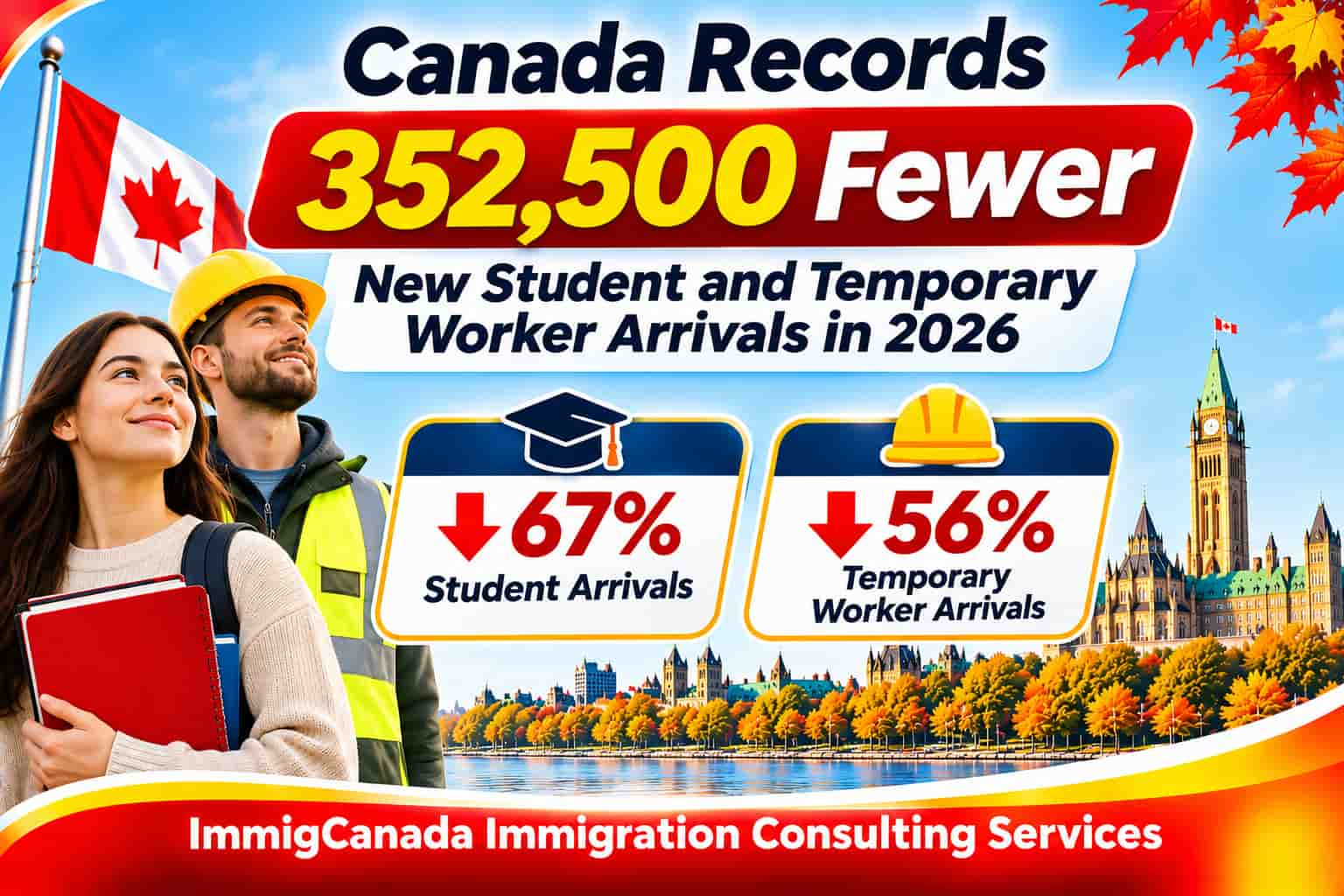

Canada has recorded a significant decline in new international student and temporary worker arrivals during the first nine months of 2026, reflecting the federal government’s continued efforts to manage temporary immigration levels.
According to updated statistics released by Immigration, Refugees and Citizenship Canada (IRCC) on November 17, 2026, combined new international student and temporary worker arrivals declined by 61% between January and September 2026 compared with the same period in 2024.
Canada recorded 83,110 new international student arrivals, representing a 67% decrease, while new temporary worker arrivals fell to 145,045, down 56%.
The latest figures indicate that Canada is progressing towards its annual temporary resident targets, with IRCC expecting new arrivals to remain within the respective targets of 155,000 international students and 230,000 temporary workers.
Meanwhile, the number of former temporary residents transitioning to permanent residence has increased. Between January and September 2026, 183,030 former temporary residents became permanent residents, accounting for 59% of all new permanent residents during the period.
The latest developments highlight a changing Canadian immigration landscape, with fewer new temporary residents entering the country and a growing share of permanent residents coming from Canada’s existing temporary resident population.
Canada Records 61% Decline in New Student and Worker Arrivals
The latest IRCC figures show that Canada recorded substantially fewer new international students and temporary workers during the first nine months of 2026 compared with the corresponding period in 2024.
Here is a breakdown of the reported arrivals:
| Temporary resident category | New arrivals, Jan–Sept 2026 | Change compared with 2024 |
| International students | 83,110 | 67% decrease |
| Temporary workers | 145,045 | 56% decrease |
| Combined decline | 352,500 fewer arrivals | 61% decrease |
The decline reflects Canada’s broader approach to managing temporary resident admissions and reducing pressure on housing, infrastructure and public services.
The federal government has introduced several policy measures over recent years to regulate the number of temporary residents entering the country, particularly international students and temporary foreign workers.
Source: Understanding student and temporary worker numbers in Canada
International Student Arrivals Decline by 67%
Canada recorded 83,110 new international student arrivals between January and September 2026, representing a 67% decline compared with the same period in 2024.
The decrease follows several policy changes introduced by the federal government to manage international student admissions.
Study Permit Cap and Provincial Attestation Requirements
One of the major changes affecting international students was the introduction of a study permit cap.
Canada introduced limits on the number of study permits issued, alongside provincial and territorial attestation letter requirements for many applicants.
These measures were intended to manage the growth of the international student population and ensure that study permit admissions remained within the government’s immigration objectives.
Post-Graduation Work Permit Reforms
Canada also introduced changes to Post-Graduation Work Permit (PGWP) eligibility.
The reforms included changes to eligible fields of study for certain college graduates and language proficiency requirements for different categories of applicants.
These changes have affected the post-study work options available to some international graduates.
Students considering studying in Canada should therefore review the latest PGWP eligibility requirements before selecting a program or institution.
What Does This Mean for Future International Students?
The decline in new international student arrivals highlights the importance of careful planning before applying for a Canadian study permit.
Prospective students should consider:
- Whether their chosen institution is a Designated Learning Institution (DLI).
- Whether their program meets applicable study permit and PGWP requirements.
- Whether they need a provincial or territorial attestation letter.
- Whether they can demonstrate sufficient financial resources.
- Whether they meet the current study permit eligibility requirements.
A Canadian study permit does not automatically guarantee eligibility for a Post-Graduation Work Permit or permanent residence.
Students should evaluate the long-term implications of their education choices before submitting an application.
Temporary Worker Arrivals Fall by 56%
Canada also recorded a significant reduction in new temporary worker arrivals.
According to IRCC, 145,045 new temporary workers arrived between January and September 2026, representing a 56% decline compared with the same period in 2024.
The decline follows several federal policy changes affecting temporary foreign worker admissions.
Restrictions on Low-Wage Temporary Foreign Workers
Canada introduced tighter restrictions on employers seeking to hire temporary foreign workers under the low-wage stream of the Temporary Foreign Worker Program.
These measures include restrictions affecting the proportion of low-wage temporary foreign workers an employer can hire and limitations on processing certain Labour Market Impact Assessment (LMIA) applications in areas experiencing elevated unemployment.
The changes aim to encourage employers to prioritize Canadian citizens and permanent residents where possible.
Changes to Spousal Open Work Permit Eligibility
The federal government also restricted eligibility for open work permits for family members of certain temporary foreign workers.
Under the revised rules, eligibility is limited to spouses of workers in specified occupations and employment situations, subject to applicable conditions.
These changes have reduced the number of accompanying family members who may qualify for open work permits through a principal temporary foreign worker.
What Does This Mean for Foreign Workers?
Foreign nationals planning to work in Canada should carefully assess the available work permit categories and current eligibility requirements.
Depending on their circumstances, applicants may explore:
- Employer-specific work permits.
- Labour Market Impact Assessment-supported work permits.
- LMIA-exempt work permits.
- International mobility pathways.
- Other eligible work permit categories.
The appropriate option depends on the applicant’s occupation, qualifications, employer, job offer and applicable immigration provisions.
Canada Expects Student and Worker Arrivals to Remain Within 2026 Targets
Despite the significant decline in new arrivals, IRCC expects Canada to remain within its annual targets for international students and temporary workers.
The respective targets are:
| Category | 2026 annual target |
| International students | 155,000 |
| Temporary workers | 230,000 |
These targets form part of Canada’s broader approach to managing temporary resident admissions.
It is important to distinguish between annual targets and actual arrivals recorded during a particular reporting period. The 83,110 student arrivals and 145,045 worker arrivals represent figures for January to September, not the full-year totals.
The final number of arrivals will depend on admissions during the remaining months of 2026.
Canada Has 562,325 Study Permit Holders and 1.55 Million Work Permit Holders
The latest IRCC statistics also provide an overview of Canada’s existing temporary resident population.
As of September 30, 2026, Canada had:
- 562,325 study permit holders.
- 1,550,020 individuals holding only a work permit.
The work permit figure excludes asylum claimants, protected persons and related groups identified in the reported statistics.
These figures represent individuals holding the respective permits at the reporting date, rather than the number of new arrivals during the first nine months of the year.
The distinction is important because the number of new temporary residents entering Canada during a particular period is different from the total number of individuals already holding valid temporary residence authorization.
More Former Temporary Residents Transition to Permanent Residence
One of the most notable developments in the latest IRCC statistics is the increasing proportion of new permanent residents who previously held temporary resident status in Canada.
Between January and September 2026, 183,030 former temporary residents became permanent residents.
This represented 59% of all new permanent residents during the period.
The proportion is significantly higher than in previous years:
| Year | Share of new permanent residents who were former temporary residents |
| 2024 | 44% |
| 2025 | 48% |
| 2026 (January–September) | 59% |
The figures indicate that an increasing share of Canada’s permanent resident admissions is coming from individuals who were already living in the country as temporary residents.
These individuals may include former international students and temporary foreign workers who subsequently qualified for permanent residence through eligible economic immigration programs.
Why Is the Transition from Temporary to Permanent Residence Increasing?
Canada has several economic immigration pathways through which eligible temporary residents can transition to permanent residence.
These include:
1. Canadian Experience Class (CEC)
The CEC is an Express Entry program for eligible candidates with qualifying Canadian skilled work experience.
2. Provincial Nominee Programs (PNPs)
Provincial and territorial nominee programs allow participating jurisdictions to nominate eligible foreign nationals who meet their economic and labour market priorities.
3. Federal Skilled Worker Program (FSWP)
The FSWP provides a permanent residence pathway for eligible skilled workers with qualifying foreign or Canadian work experience who meet its selection criteria.
4. Other eligible economic immigration pathways
Depending on their circumstances, candidates may qualify through other federal or regional economic immigration programs.
However, holding a study permit or work permit does not automatically make someone eligible for permanent residence. Candidates must satisfy the requirements of the specific immigration program.
What Do the Latest Temporary Resident Statistics Mean for Canada’s Immigration Policy?
The November 2026 statistics highlight a significant shift in Canada’s approach to temporary immigration.
Three important developments stand out.
First, new international student arrivals have declined substantially. The 67% reduction reflects the impact of tighter study permit admissions and changes to post-study work eligibility.
Second, new temporary worker arrivals have also decreased. The 56% decline follows restrictions on low-wage hiring and changes to work permit eligibility for certain family members.
Third, more permanent residents are coming from Canada’s existing temporary resident population. Former temporary residents accounted for 59% of all new permanent residents during the first nine months of 2026, compared with 44% in 2024.
For prospective international students and foreign workers, these developments underline the importance of understanding Canada’s current immigration priorities.
Applicants should not assume that obtaining temporary residence will automatically lead to permanent residence. Instead, they should evaluate available immigration pathways and eligibility requirements before making long-term immigration decisions.
Frequently Asked Questions
Combined new international student and temporary worker arrivals declined by 61% between January and September 2026 compared with the same period in 2024, representing approximately 352,500 fewer arrivals.
Canada recorded 83,110 new international student arrivals between January and September 2026, representing a 67% decline compared with the same period in 2024.
IRCC recorded 145,045 new temporary worker arrivals between January and September 2026, down 56% compared with the same period in 2024.
Canada’s 2026 target for new international student arrivals is 155,000.
Canada expects new temporary worker arrivals to remain within its annual target of 230,000.
As of September 30, 2026, Canada had 562,325 study permit holders.
IRCC reported 1,550,020 individuals holding only a work permit as of September 30, 2026, excluding asylum claimants, protected persons and related groups.
Canada introduced study permit caps and other measures to manage the growth of its international student population, address pressures on housing and public services, and improve the integrity of the international education system.
The federal government introduced restrictions on certain low-wage temporary foreign worker hiring, changes to work permit eligibility for spouses and other measures to manage temporary resident levels and prioritize opportunities for Canadian workers.
Yes. Eligible international graduates may still qualify for a PGWP, but eligibility depends on factors such as the institution, program of study, applicable field-of-study requirements and language criteria. Not every study program qualifies.
Yes. Eligible temporary foreign workers may qualify for permanent residence through programs such as the Canadian Experience Class, Provincial Nominee Programs and other economic immigration pathways. They must meet the relevant program requirements.
A total of 183,030 former temporary residents became permanent residents between January and September 2026.
Former temporary residents represented 59% of all new permanent residents during the first nine months of 2026, compared with 48% in 2025 and 44% in 2024.
No. A study permit only authorizes an eligible foreign national to study in Canada under specified conditions. Graduates must independently qualify for an applicable permanent residence program.
Eligible international graduates may apply for a Post-Graduation Work Permit if they meet the applicable requirements. Other work permit pathways may also be available depending on individual circumstances.
Planning to Study, Work or Settle Permanently in Canada?
Canada’s changing temporary resident policies are making it increasingly important for international students and foreign workers to understand their long-term immigration options before applying.
Whether you are planning to study in Canada, explore temporary work opportunities or transition from temporary residence to permanent residence, choosing the right pathway requires careful assessment of your eligibility and immigration goals.
At ImmigCanada, RCIC Eivy Joy Quito can help you understand the latest Canadian immigration policies, assess your eligibility for available study, work and permanent residence pathways, and make informed decisions about your future in Canada.
Thinking about making Canada your next home? Contact ImmigCanada today to discuss your immigration goals with RCIC Eivy Joy Quito and explore the pathway that best fits your circumstances.