

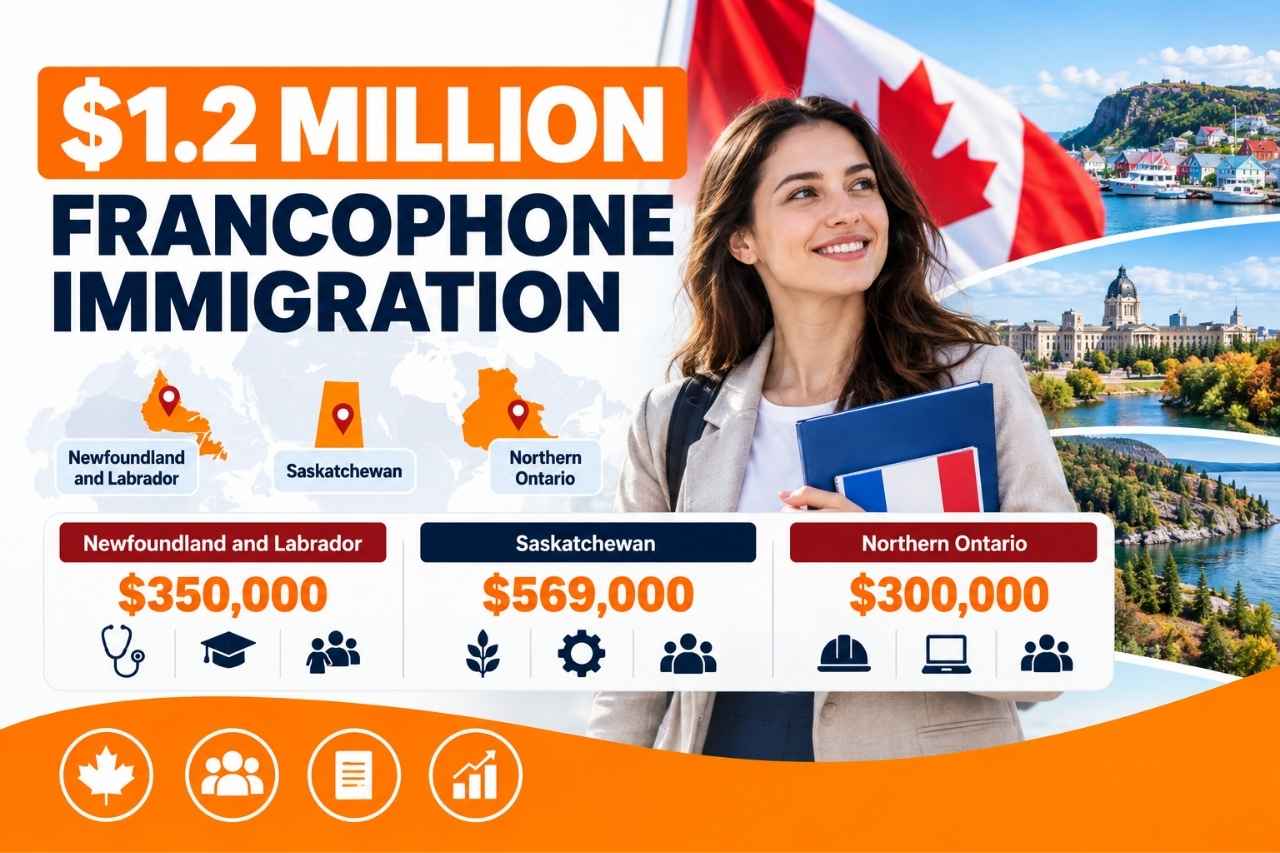

Canada is investing approximately $1.2 million in new projects designed to attract and retain Francophone and bilingual newcomers in Newfoundland and Labrador, Saskatchewan and Northern Ontario. Announced by Immigration, Refugees and Citizenship Canada (IRCC) on September 29, 2026, the funding is being provided through the Francophone Immigration Support Program (FISP).
The projects offer an important look at how Canada is approaching Francophone immigration outside Québec, particularly by connecting immigration with regional labour-market needs.
Where the $1.2 Million Will Go?
The funding supports three initiatives:
| Region | Initiative | Main objective |
| Newfoundland and Labrador | Francophone and bilingual recruitment corridor | Attract talent in key sectors |
| Saskatchewan | Destination Saskatchewan | Match Francophone talent with labour-market needs |
| Northern Ontario | Osez le Nord | Promote regional Francophone immigration |
IRCC says the projects are designed to strengthen Francophone minority communities while supporting population growth and labour-market needs.
Newfoundland and Labrador: Building a Francophone Recruitment Corridor
The Government of Newfoundland and Labrador will lead a project designed to create a sustainable recruitment corridor for Francophone and bilingual talent.
The initiative will use targeted overseas recruitment to attract people who can contribute to important sectors, including:
- Health care
- Education
- Early childhood education
The project has received $350,000 over two years.
The broader goal is not simply to attract newcomers but to strengthen Francophone and bilingual capacity in the province’s public and private sectors.
For immigration candidates, this highlights an important trend: Canada’s regional immigration efforts increasingly connect candidate recruitment with specific labour-market needs.
Official Source: Canada is supporting new projects to promote Francophone immigration
Saskatchewan: Connecting Employers With Francophone Talent
Saskatchewan’s initiative is designed to directly connect local labour-market demand with international Francophone talent.
The project, led by the Conseil économique et coopératif de la Saskatchewan, received $569,000 over two years.
Its activities include:
- An interactive demand-and-supply mapping platform
- Pre-selection tools
- Recruitment missions
- Academic credential recognition support
- Professional certification support
- Cultural transition workshops
- Follow-up support after arrival
The initiative targets employers in sectors such as:
- Agriculture
- Health care
- Mining
- Energy
- Technology
- Hospitality
This is particularly relevant for Francophone professionals because finding an immigration pathway and finding a realistic employment opportunity are not always the same thing.
A program that connects international talent with employers and credential-recognition resources can address several of those challenges at once.
Northern Ontario: Osez le Nord
The third project focuses on Northern Ontario.
The second phase of Osez le Nord received $300,000 over two years.
The campaign aims to bring together key stakeholders involved in Francophone immigration across Northern Ontario and promote the opportunities available in Francophone communities.
Rather than treating immigration as a purely national process, the initiative places greater emphasis on regional opportunities, careers and community life.
That matters because regional immigration can help distribute newcomers beyond Canada’s largest urban centres.
Why Francophone Immigration Matters to Canada?
Canada’s Francophone immigration strategy is about more than language.
Francophone communities outside Québec form an important part of Canada’s linguistic and cultural landscape.
The federal Francophone Immigration Support Program is designed to increase the involvement of Francophone stakeholders in immigration and address French-speaking and bilingual labour needs outside Québec.
IRCC also reported that Francophone permanent resident admissions outside Québec reached 8.9% in 2025.
The government has also set a broader target of reaching 12% Francophone immigration among permanent resident admissions outside Québec by 2029.
What This Means for Francophone Immigration Candidates
The latest funding announcement does not create a new permanent residence program.
That distinction is important.
Instead, the investment supports projects that can help attract, recruit and retain Francophone and bilingual talent.
For candidates, the development may be relevant if they are considering immigration outside Québec and have French-language skills.
Depending on their profile, candidates may explore options such as Express Entry, Provincial Nominee Programs, regional immigration pathways and other programs where French-language ability may be relevant.
However, French proficiency alone does not guarantee permanent residence.
Candidates still need to meet the eligibility requirements of the specific immigration pathway.
Regional Immigration Is Becoming More Important
One of the most interesting aspects of the announcement is the focus on regions.
Newfoundland and Labrador, Saskatchewan and Northern Ontario have different labour-market requirements and demographic needs.
The projects are therefore not simply promoting Canada as one destination.
They are promoting specific communities and connecting immigration with local opportunities.
For prospective immigrants, this means location can become an important part of immigration planning.
Instead of asking only:
“Can I immigrate to Canada?”
candidates may also need to ask:
“Which Canadian community needs my skills and offers a pathway that fits my profile?”
That shift can lead to more realistic immigration planning.
What Applicants Should Consider
Francophone or bilingual applicants considering Canada should review:
- French-language test results
- English-language ability
- Occupation and NOC
- Education
- Work experience
- Provincial or regional eligibility
- Employment opportunities
- Credential-recognition requirements
- Express Entry eligibility
- Provincial nomination options
A strong French-language profile can be valuable, but it should be considered alongside the rest of the candidate’s profile.
The Bigger Immigration Picture
The $1.2 million investment reflects a broader Canadian immigration strategy: attracting newcomers who can contribute to labour-market needs while strengthening communities outside Canada’s largest population centres.
For Francophone candidates, that could mean more recruitment initiatives, stronger regional connections and greater visibility for communities outside Québec.
It does not mean that every candidate will receive a new immigration opportunity.
Instead, it signals that Francophone immigration remains an important part of Canada’s broader immigration planning.
FAQs
The Government of Canada announced approximately $1.2 million in funding.
The projects are in Newfoundland and Labrador, Saskatchewan and Northern Ontario.
No. The funding supports Francophone immigration projects rather than creating a new permanent residence program.
The project focuses on areas including health care, education and early childhood education.
The Saskatchewan project targets agriculture, health care, mining, energy, technology and hospitality.
It is a coordinated promotional initiative focused on Francophone immigration in Northern Ontario.
No. French-language ability can be relevant to certain immigration pathways, but candidates must meet the requirements of the specific program.
No. The federal government specifically supports Francophone immigration to communities outside Québec.