

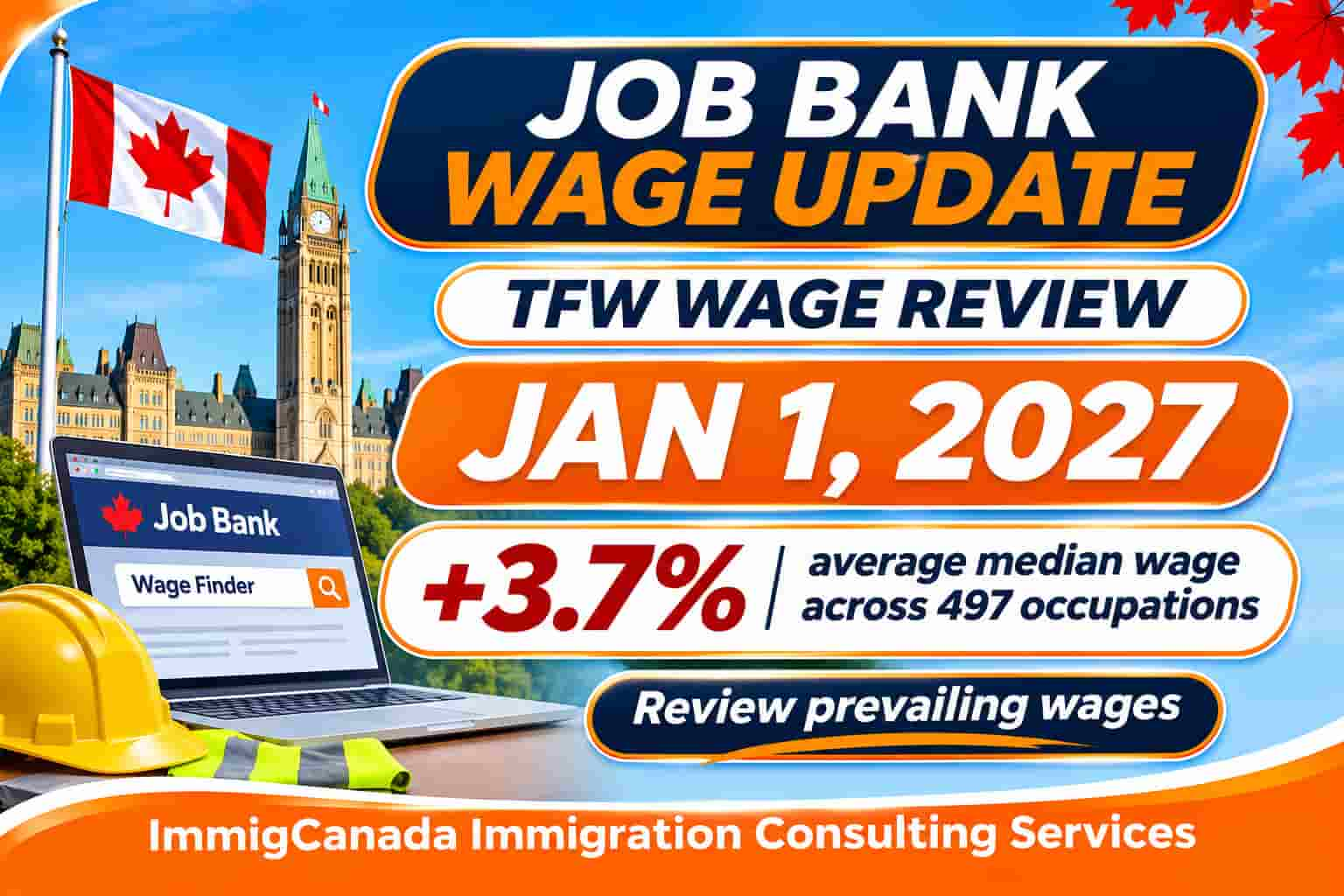

The TFWP prevailing wage update 2026 is relevant to Canadian employers hiring temporary foreign workers under the Temporary Foreign Worker Program (TFWP). Employment and Social Development Canada (ESDC) confirms that the fall 2026 Job Bank wage update took place on November 18, 2026.
Employers covered by the prevailing wage review requirements must assess the updated wage information and make any required adjustments by January 1, 2027. The annual review is intended to ensure that temporary foreign workers continue to receive wages consistent with the prevailing rate for their occupation and work location.
The government has not confirmed the 3.7% nationwide average increase stated in the supplied draft. Employers should check the applicable wage for each occupation and location rather than applying a single national percentage.
ESDC Job Bank Wage Revisions Explained
The prevailing wage is an important part of the LMIA process. Employers must offer temporary foreign workers wages that meet the applicable requirements for the occupation and location. The Job Bank wage tool provides median hourly wage information by occupation and geographic area.
For many TFWP positions, employers must review the prevailing wage using the updated Job Bank information each year. The federal government gives employers until January 1 of the following year to complete the annual review.
The ESDC prevailing wage compliance process requires employers to consider the specific occupation, work location and applicable program rules. The relevant wage is not necessarily the same across provinces or communities.
| Compliance Factor | Current Requirement |
| Publishing agency | Employment and Social Development Canada |
| Wage information | Government of Canada Job Bank |
| Fall 2026 update | November 18, 2026 |
| Annual review deadline | January 1, 2027 |
| Wage assessment | Applicable occupation and geographic location |
| Non-compliance consequences | Possible administrative monetary penalties and program bans |
For employers, the job bank median wage by province is a useful starting point, but the correct wage may be based on a more specific community or economic region. Employers should also consider whether an industry-specific wage rule applies.
The updated wage cannot fall below the wage identified in a positive LMIA during the temporary foreign worker’s employment, even if the prevailing wage later decreases.
Impact on High-Wage vs. Low-Wage LMIA Streams
Updated median wages can also affect how employers classify a position under the high-wage or low-wage LMIA streams. This classification is based on the applicable provincial or territorial median wage threshold, not simply on whether the offered wage is competitive for the occupation.
Employers should distinguish between two related but separate assessments:
- Prevailing wage: The wage an employer must offer and maintain for the specific occupation and work location.
- High-wage or low-wage threshold: The applicable median wage used to determine which LMIA stream and associated requirements apply.
A change in the Job Bank median may affect the stream classification of a future application. Employers should not assume that every existing position automatically moves from one stream to another because of the annual wage update.
Immediate Action Items for Canadian Employers
- Audit active LMIA positions: Identify temporary foreign workers whose employment is covered by the annual prevailing wage review. Compare each worker’s wage with the applicable updated wage for the occupation and location.
- Execute payroll adjustments by January 1, 2027: Where the updated prevailing wage requires an increase, revise payroll so the worker receives the required amount by the deadline.
- Verify pending LMIA submissions: Employers preparing new applications should use the current wage information. An offer below the applicable prevailing wage may result in a negative LMIA.
- Retain supporting records: Keep wage comparisons, payroll records, employment agreements and documentation showing how the applicable wage was determined.
The temporary foreign worker wage increase canada requirement is not a flat increase applied to every worker. The adjustment depends on the individual position and the applicable wage information.
Avoiding Severe ESDC Compliance Penalties
Employers must comply with the conditions attached to their LMIA and the TFWP. This includes paying the required wage and maintaining the working conditions promised to the worker.
Failure to meet program requirements can lead to employer compliance action. Depending on the nature and seriousness of the violation, consequences may include administrative monetary penalties, restrictions on hiring temporary foreign workers and a public listing as a non-compliant employer.
The TFWP wage deadline 2027 should therefore be treated as an important annual payroll review date. Employers should not rely on a general percentage increase or an outdated wage table. Eivy Joy Quito, licensed Regulated Canadian Immigration Consultant (RCIC #R512178), has more than a decade of Canadian immigration consulting experience. Employers can seek professional guidance to review their immigration-related obligations, understand LMIA requirements and identify documentation needed for a compliant hiring process
Frequently Asked Questions
Employers subject to the annual prevailing wage review must review the updated Job Bank wages and make any required adjustments by January 1, 2027. The fall 2026 Job Bank wage update took place on November 18, 2026.
Employers must review the applicable prevailing wage for covered positions and adjust wages where required. The updated wage must not fall below the wage specified in the positive LMIA during the worker’s employment, even if the prevailing wage subsequently decreases. The requirement does not mean every temporary foreign worker must receive the same percentage increase.
Employers who fail to meet TFWP wage and employment conditions may face administrative monetary penalties, restrictions on hiring temporary foreign workers and possible bans from the program. The consequences depend on the nature and seriousness of the violation.