

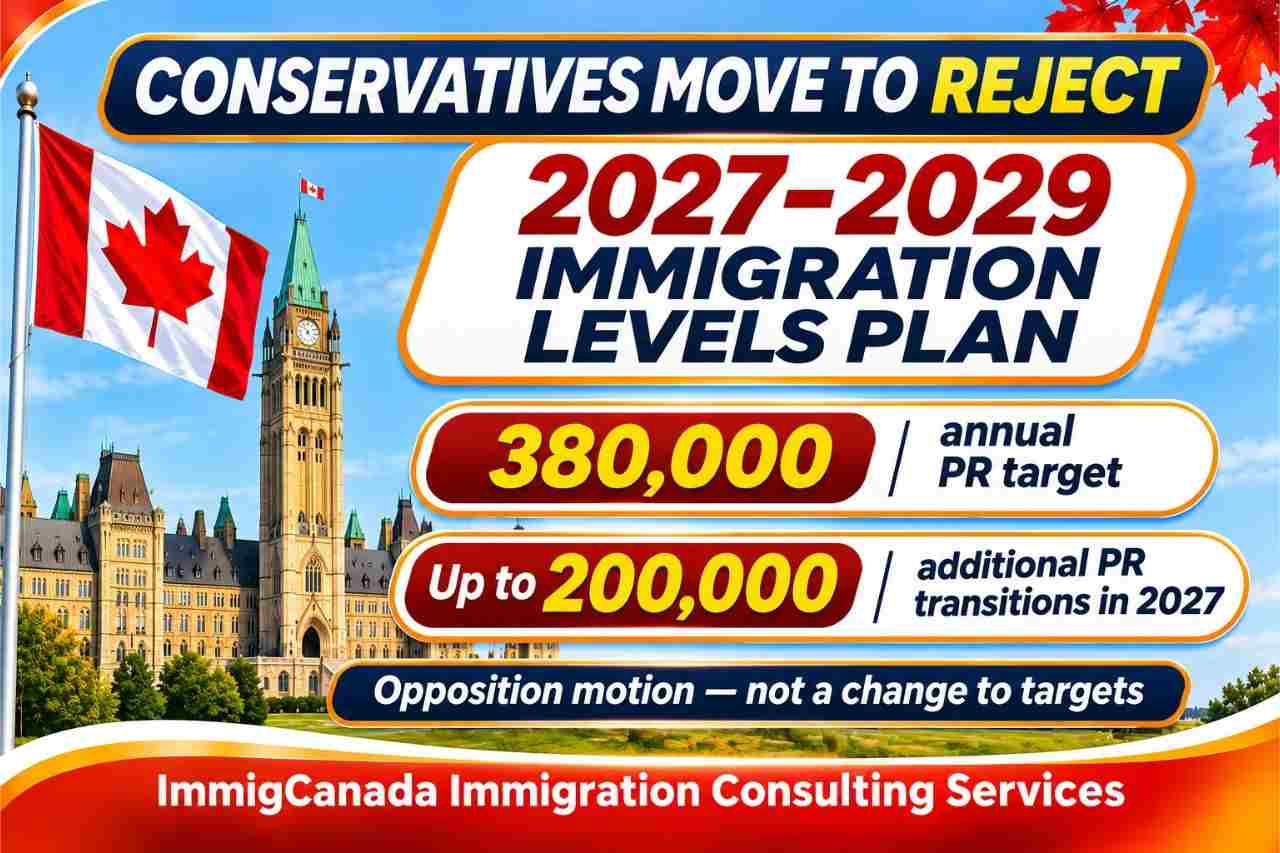

Canada immigration levels plan 2027 has become a major subject of political debate following the Conservative Party’s move to challenge the federal government’s permanent resident admission targets in the House of Commons. Conservative Leader Pierre Poilievre and Immigration Critic Michelle Rempel Garner have called on MPs to reject the government’s proposed increase in permanent immigration, arguing that housing, healthcare, employment and public infrastructure must be able to keep pace with population growth.
The motion comes after the federal government released its 2027–2029 Immigration Levels Plan on November 5, 2026. The plan maintains permanent resident admissions at 380,000 annually for 2027, 2028 and 2029. However, the political disagreement extends beyond this headline figure because the government has also announced additional, time-limited measures that could increase the number of people transitioning to permanent residence in 2027.
According to The Canadian Press, the Conservatives have argued that the combined measures could bring the potential number of permanent resident admissions in 2027 to approximately 662,000. The government maintains that many of the people covered by the additional measures are already living in Canada, which means their transition to permanent residence would not create the same population pressures as an equivalent number of new arrivals.
Key Demands in the Parliamentary Motion
The Conservative motion asks the House of Commons to reject the Prime Minister’s plan to increase permanent immigration next year to what the party describes as the highest level in Canadian history. Its stated concern is that housing, wages, healthcare, jobs and other social services should keep pace with population growth.
The wider Conservative position, as described in the supplied brief and public statements, focuses on three policy areas:
- Immediate Freeze on PR Admissions: The Conservatives have called for a pause or reduction in immigration admissions until the country has sufficient housing and public service capacity. Their argument centres on the relationship between population growth, housing availability, employment conditions and access to healthcare. The party has also referred to housing delivery and infrastructure capacity when discussing the need to reconsider immigration targets.
- Mandatory Municipal Impact Assessments: The supplied brief identifies municipal impact assessments as another proposed direction. This would place greater emphasis on the capacity of communities to accommodate population growth, including housing supply, healthcare staffing, transportation and other public services. However, these requirements should be understood as broader policy proposals rather than confirmed clauses in the motion itself.
- Prioritization of In-Country Transitions: The Conservatives have also challenged the government’s approach of transitioning people already in Canada to permanent residence through additional measures. Their position is that immigration planning should consider the country’s existing employment and infrastructure pressures. The government, in contrast, argues that people already living and working in Canada are integrated into communities and that granting them permanent residence can support regional labour needs.
The motion’s actual wording is narrower than the three-part policy description in the supplied brief. It asks MPs to reject the government’s proposed increase in permanent immigration. It does not itself establish a statutory ceiling, introduce municipal assessment requirements or direct IRCC to change the selection rules for temporary residents.
What This Means for Prospective Immigrants
The debate over the immigration levels plan Canada 2027-2029 is important for people considering permanent residence, but a parliamentary motion does not automatically change immigration eligibility or application procedures.
IRCC’s published plan sets permanent resident admissions at 380,000 annually. The economic category accounts for 64.4% of planned admissions, while the Provincial Nominee Program has an annual target of 95,000 for each of the three years.
The plan also sets new temporary resident arrival targets at 370,000 annually, comprising 220,000 workers and 150,000 international students. These targets are intended to provide greater predictability for employers, educational institutions and provincial governments.
The federal government has also introduced a time-limited measure covering two groups of people already in Canada:
- A workers cohort intended to transition in-Canada workers and their accompanying family members to permanent residence in collaboration with provinces and territories.
- A humanitarian cohort intended to transition people who have been waiting in Canada for many years.
These measures are relevant to people already working or living in Canada, but they do not mean that every temporary resident will automatically qualify for permanent residence. Applicants must still meet the requirements of the applicable pathway and any selection criteria established by the responsible authorities.
Could Canada Introduce a PR Cap in 2027?
The phrase Canada PR cap 2027 has gained attention because of the Conservative proposal to reconsider immigration admissions. However, Canada already publishes annual permanent resident targets and operational ranges through its Immigration Levels Plan.
For 2027, the federal government has set a target of 380,000 permanent resident admissions, with a planning range of 352,500 to 422,000. The target is not the same as a new statutory ceiling proposed by a political party.
A statutory cap would require a separate government decision and the appropriate legislative or regulatory action. The Conservative motion, by itself, does not introduce such a limit or amend the Immigration and Refugee Protection Act.
Prospective applicants should therefore distinguish between a political proposal and an implemented immigration policy. Until the government announces a formal change, existing program requirements remain the basis for assessing applications.
Will Immigration Admissions Shift Towards Applicants Already in Canada?
The federal plan includes measures to transition certain workers and humanitarian cohorts already living in Canada to permanent residence. This reflects the government’s intention to retain people who are already contributing to Canadian communities and regional labour markets.
Temporary Foreign Worker and eligible individuals with Canadian work experience may find these policy developments relevant. However, being in Canada does not automatically create eligibility for permanent residence.
Candidates may still need to demonstrate qualifying work experience, language ability, education, employment arrangements or other requirements under the relevant program. Those considering Express Entry or a Provincial Nominee Program should review the selection rules that apply to their individual circumstances.
Applicants outside Canada should also avoid assuming that overseas immigration applications will be suspended. The published plan continues to include federal economic immigration, provincial nominations, family sponsorship and refugee admissions.
What Applicants Should Do Next
People planning to immigrate to Canada should monitor official government announcements rather than make decisions based solely on political statements. A proposed motion may influence parliamentary debate, but it does not immediately alter the eligibility criteria of Express Entry or provincial immigration programs.
Candidates can use this period to review their qualifications, maintain valid temporary status where applicable, prepare language test results and educational documents, and assess whether their occupation aligns with provincial labour market needs.
Eivy Joy Quito, ImmigCanada’s licensed Regulated Canadian Immigration Consultant (RCIC R512178), has more than a decade of experience in Canadian immigration consulting. She can help applicants evaluate their eligibility, understand how federal policy developments may affect their options, and prepare applications under the relevant immigration pathways. Her guidance is based on each applicant’s individual profile and the rules in effect at the time of application.
The debate over Canada’s immigration targets reflects continuing disagreements about how population growth should be balanced with housing, healthcare, employment and infrastructure capacity. The federal Canada immigration levels plan 2027 maintains permanent resident admissions at 380,000 annually through 2029, while also introducing additional measures for people already living in Canada.
The Conservative motion brings these issues into parliamentary debate, but it does not itself change Canada’s immigration rules. Prospective immigrants should continue to follow official IRCC announcements and assess their options using current program requirements.
Frequently Asked Questions
Canada’s 2027-2029 Immigration Levels Plan sets a permanent resident admission target of 380,000 for each year. It also establishes annual targets of 370,000 new temporary resident arrivals.
The Conservatives argue that immigration admissions should reflect Canada’s ability to provide housing, healthcare, employment opportunities and public infrastructure. They have called on the House of Commons to reject the proposed increase in permanent immigration.
The federal government has published a target of 380,000 permanent resident admissions for 2027, with an operational range. The Conservative motion does not itself introduce a new statutory cap.
The federal plan includes time-limited measures to transition certain workers and humanitarian cohorts already in Canada to permanent residence. Eligibility will depend on the applicable criteria and implementation arrangements.
Yes. Federal high-skilled economic immigration remains part of the plan. Express Entry candidates should monitor IRCC announcements for category-based selection priorities and changes to program requirements.