



Yes. Saskatchewan’s September 14–15, 2026 capped-sector intake for retail, trucking, accommodation and food services reached its limits in every sector, with all 550 available positions claimed. Food Services, the last sector to open, filled all 175 spots on September 15. This was the final capped-sector intake of the year; a previously scheduled November window has been cancelled.
What Happened During Saskatchewan’s Final 2026 Capped Sector Intake?
Saskatchewan closed out its 2026 capped-sector allocation on September 14 and 15, running staggered Employer Position Assessment (EPA) intake windows for four sectors: retail trade, trucking and transportation, accommodation, and food services. Each window opened at a fixed time and closed the moment its position count was reached, on a strict first-come, first-served basis through the province’s OASIS portal.
By the time the Food Services window closed on the afternoon of September 15, every one of the 550 positions across all four sectors had been claimed. Retail and Trucking opened first, at 9:30 a.m. on September 14, followed by Accommodation at 1:30 p.m. the same day, and Food Services at 1:30 p.m. on September 15.
How Many Positions Were Available In Each Sector?
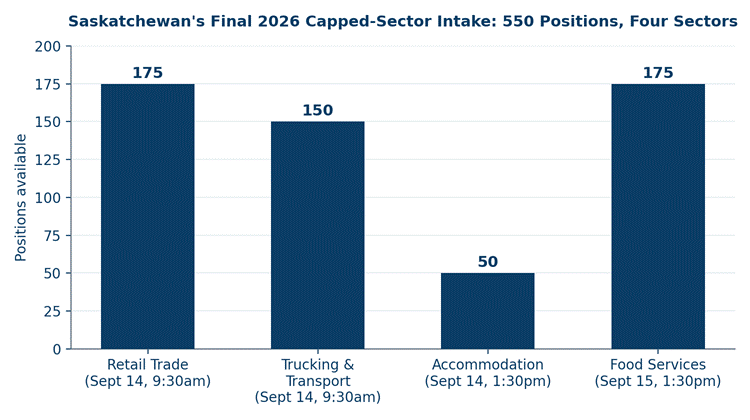
Positions available by sector in Saskatchewan’s September 14–15, 2026 capped-sector intake.
Retail trade and other services carried the largest allocation at 175 positions, matched exactly by Food Services. Trucking and transportation offered 150 positions, and Accommodation — the smallest and historically fastest-filling sector — had 50. Saskatchewan’s total 2026 nomination allocation sits at 4,761, and the province has capped these three original sectors (accommodation, food services combined with retail and trucking) at no more than roughly 25 percent of that total, or about 1,190 nominations, to keep space available for priority sectors like health, agriculture and the skilled trades.
This September window was also unusually large because it absorbed positions that had originally been reserved for a November intake. With that November window now cancelled, there is no further capped-sector opportunity in Saskatchewan until the province’s 2027 allocation opens.
Who Was Eligible For The September SINP Intake?
This intake was never designed as a recruitment tool for hiring new workers from outside Canada. Its purpose is narrower: keeping foreign workers who are already employed in Saskatchewan from falling out of status. Eligibility reflected that directly. A worker needed six months or less remaining on a valid work permit for their employer to submit an EPA on their behalf; an application for someone with more runway on their permit would be returned outright.
The employer, not the worker, files the EPA through OASIS, and must be registered and in good standing, with the position itself being genuine, full-time, and permanent in one of the capped sectors at an appropriate wage. Once an EPA is conditionally approved — a process that has been taking three to four weeks in 2026 — the worker has a short validation step and then 60 days to submit a full nomination application. Missing that window releases the position back to the province.
What Are Your Options If You Missed The September Window?
For employers and workers who didn’t secure a spot, the door on Saskatchewan’s capped sectors is closed until 2027, but it isn’t the only door. A priority-sector EPA remains available year-round for workers whose actual duties genuinely fall under an occupation Saskatchewan is prioritizing outside the capped list, such as health, agriculture, or the skilled trades — though attempting to reclassify a capped-sector role to fit a priority occupation is scrutinized closely at assessment and can put an employer’s standing with the program at risk.
A Labour Market Impact Assessment-based work permit extension is another route, buying time for the 2027 SINP allocation, though August 2026 changes to LMIA rules tightened the low-wage stream and this option needs to be assessed against the specific job and location. For workers with strong language scores and experience in higher-skill occupations, Express Entry or another province’s nominee program — Alberta’s streams, for instance — may move faster than waiting out Saskatchewan’s next window.
Frequently Asked Questions
No. The September 14–15, 2026 intake was the final capped-sector window of the year, and all 550 positions have been filled. The next opportunity is expected with Saskatchewan’s 2027 allocation.
Retail trade and other services, trucking and transportation, accommodation, and food services.
A foreign worker already employed in Saskatchewan with six months or less remaining on a valid work permit, sponsored by a registered employer in good standing.
The worker completes a validation step and then has 60 days to submit a full nomination application to the SINP.
Options include a priority-sector EPA if your role genuinely qualifies, an LMIA-based work permit extension, or exploring Express Entry or another province’s nominee program.
No. The previously scheduled November window has been cancelled, with those positions absorbed into the September intake instead.