

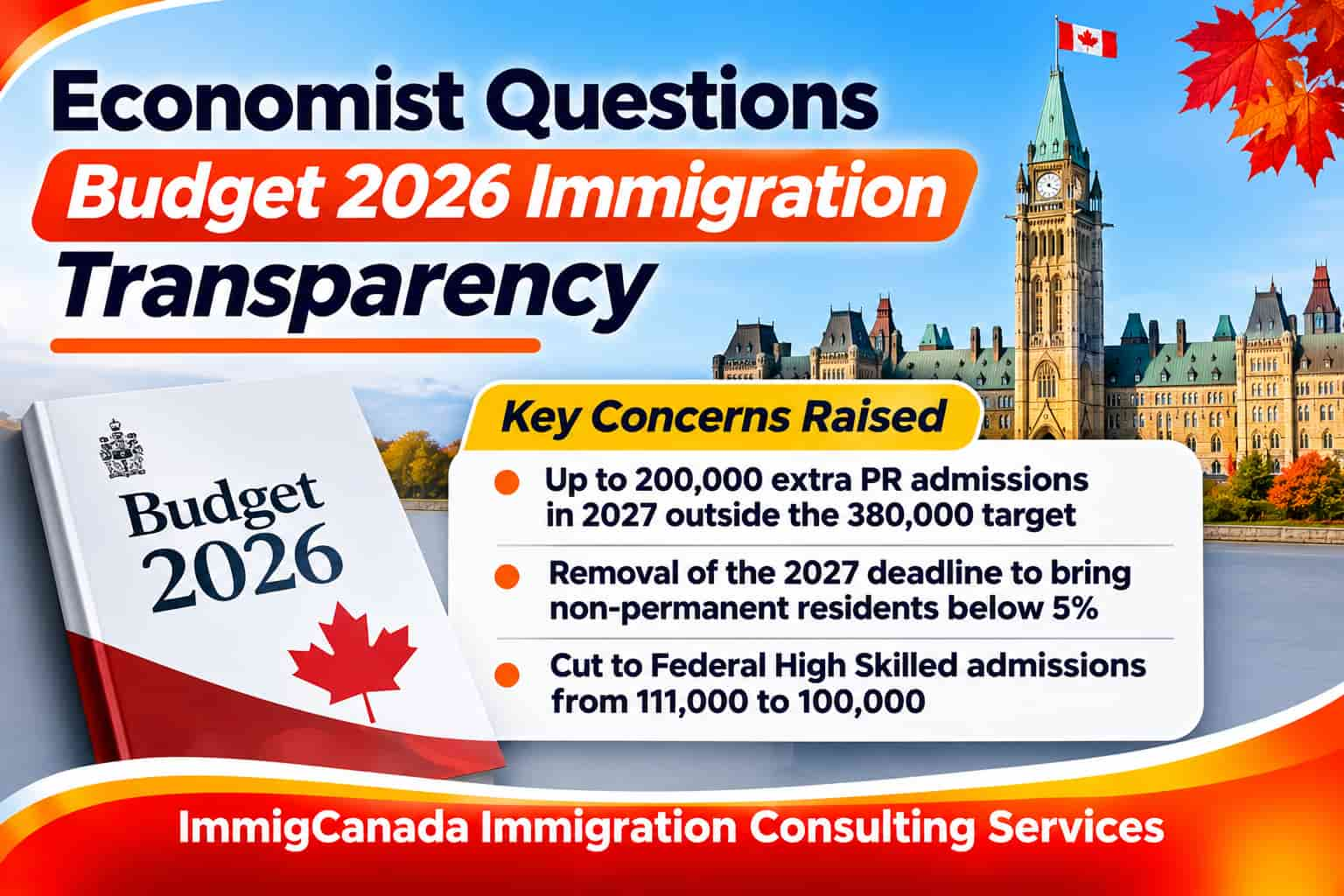

A leading economist has raised questions about Canada’s Budget 2026 immigration measures. On November 13, 2026, Parisa Mahboubi of the C.D. Howe Institute warned that the plan could weaken transparency and economic selection. Her main concern is the up to 200,000 additional permanent resident admissions in 2027 that sit outside the official 380,000 target.
Mahboubi points out that the government plans to admit 380,000 permanent residents and 370,000 new temporary residents a year from 2027 to 2029. But the extra admissions, she argues, make actual admission levels harder to see.
She raises two further points. First, she criticizes the removal of the 2027 deadline to bring non-permanent residents below 5% of the population. Second, she warns that cutting annual Federal High Skilled admissions from 111,000 to 100,000, while expanding provincial nominee pathways, could weaken skills based selection and immigrant earnings outcomes.
What Parisa Mahboubi of the C.D. Howe Institute Recommends
Mahboubi urges Ottawa to set a single comprehensive permanent resident target. She wants a firm ceiling for the temporary resident population. And she calls for transparent, skills based selection criteria.
Her argument is that clear numbers build public trust. When Canadians can see the full picture, debate becomes more informed.
Source: The Real Immigration Story in Budget 2026 Isn’t the Targets
The Government’s Case
The government describes the extra admissions as a time limited measure to support people already living in Canada. It says these individuals are already working, studying and contributing. Many have waited years for decisions. The government also says the admissions will help fulfill earlier humanitarian commitments, reduce backlogs and meet regional labour needs.
It stresses that these admissions are not new arrivals. The Parliamentary Budget Officer has noted that a similar earlier one-time pathway shrinks the temporary population without changing the number of people actually present in Canada. Other analysis points out that 200,000 is less than one in ten of the 2.15 million people holding work or study permits at the end of August 2026.
The levels plan also keeps permanent resident admissions at 380,000 a year, with more than 64% in the economic class, and aims to keep admissions below 1% of the population beyond 2027.
Why This Debate Matters
Both views have merit. Transparency matters in a democracy. A single number is easy to understand. Flexibility matters too. One time measures can address specific problems, such as long backlogs, quickly. The question is how to balance clarity with flexibility. Reasonable people can differ.
What It Means for Applicants
For people hoping to immigrate, the debate does not change current rules. The levels plan, the time limited measure and provincial programs all remain in place. But the discussion may influence future policy.
If the government adopts a more comprehensive single target in later years, the way spaces are counted could change. Skills based selection could also receive more emphasis.
Public debate is healthy. It pushes governments to explain their choices and to publish clear data. Canadians want an immigration system that is well managed, fair and transparent. For applicants, the best response is to focus on what you control. Build skills in demand. Improve language scores. Gain Canadian experience. Keep documents accurate and up to date. Follow official announcements rather than commentary alone.
For employers, plan around the published levels and provincial opportunities. Be ready for both economic selection and regional programs. We will continue to report the facts and the full range of views.
Expect more commentary as detailed program rules are released. Expect Parliament, researchers and community groups to weigh in. Watch for further details on how the 200,000 measure will work in practice.
Frequently Asked Questions
That up to 200,000 additional 2027 admissions outside the 380,000 target obscure actual admission levels.
The removal of the 2027 deadline to bring non-permanent residents below 5% of the population, and a cut in Federal High Skilled admissions from 111,000 to 100,000.
A single comprehensive permanent resident target, a firm ceiling for temporary residents and transparent skills based selection.
The measure is time limited, supports people already in Canada and fulfills earlier commitments.
Want to stay ahead of every change? Follow ImmigCanada for the latest Canada immigration news, official updates and expert insights. Bookmark ImmigCanada, subscribe to our updates and check back often. Your Canadian journey deserves reliable information.