

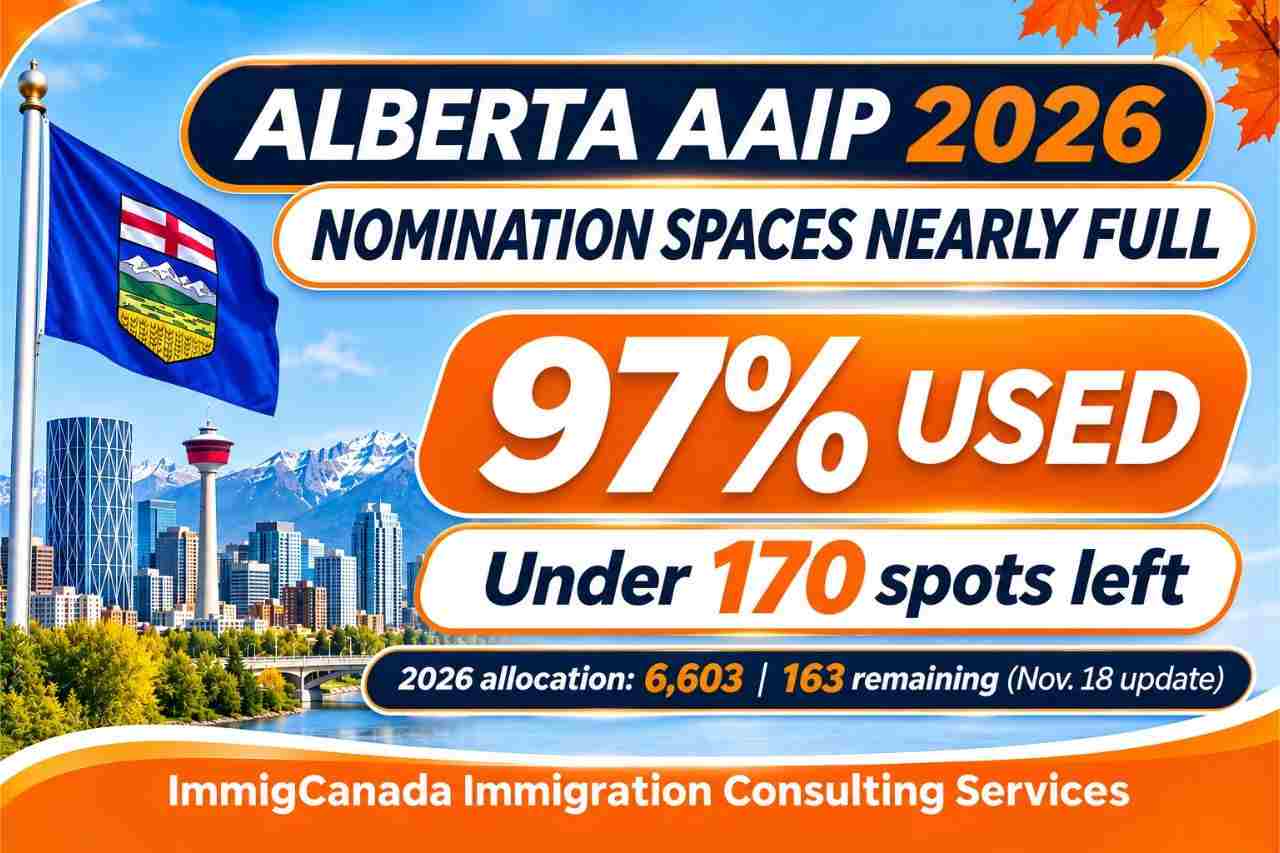

Alberta’s Advantage Immigration Program (AAIP) has used more than 97% of its 2026 provincial nomination allocation, leaving just 163 nomination spaces available out of 6,603. The latest AAIP draw activity reflects the province’s continued focus on sectors facing labour shortages, including healthcare, construction, technology, agriculture, and manufacturing. With the annual allocation nearing capacity, candidates waiting in the Expression of Interest (EOI) pool may be watching closely for further invitations and updates to Alberta’s nomination priorities.
The latest figures indicate that Alberta is approaching its annual nomination capacity. This is important for foreign workers and prospective immigrants who are waiting for an invitation, preparing an application or considering an Alberta immigration pathway
The AAIP allows eligible foreign workers, graduates and entrepreneurs to seek provincial nomination based on Alberta’s economic and labour market requirements. The province has continued to conduct selections across several streams, including the Alberta Opportunity Stream, Rural Renewal Stream, Tourism and Hospitality Stream and Alberta Express Entry pathways.
However, applicants should distinguish between the number of nomination spaces remaining and the number of applications waiting for assessment. Alberta’s latest update lists 717 applications to be processed, which is considerably higher than the 163 nomination spaces remaining. This means that being in the processing queue does not guarantee that an applicant will receive a nomination within the 2026 allocation.
AAIP Draw 2026: Current Quota and Allocation Breakdown
The Government of Alberta’s November 18 processing update provides the following figures for 2026:
| AAIP allocation information | 2026 figure |
| Total nomination allocation | 6,603 |
| Nominations issued | 6,440 |
| Nomination spaces remaining | 163 |
| Applications to be processed | 717 |
| Allocation used | Approximately 97.5% |
The province has therefore used approximately 97.5% of its standard nomination allocation. The remaining 163 spaces are spread across the program’s streams and pathways, and Alberta may redistribute allocations when required.
The stream-level figures provide a clearer picture of where nomination capacity remains:
| Stream or pathway | 2026 allocation | Nominations issued | Spaces remaining |
| Alberta Opportunity Stream | 3,562 | 3,456 | 106 |
| Rural Renewal Stream | 1,057 | 940 | 117 |
| Tourism and Hospitality Stream | 156 | 153 | 3 |
| Dedicated Health Care Pathways | 518 | 401 | 117 |
| Entrepreneur Streams | 60 | 41 | 19 |
These stream-level figures should not be added together to calculate the overall provincial balance because Alberta’s Express Entry pathways have separate administrative overage arrangements, and some additional federal spaces are tracked outside the standard allocation.
For example, the province has received additional federal spaces for eligible practice-ready physicians and Francophone candidates. Nominations issued under this federal initiative do not count towards Alberta’s standard 6,603 nomination allocation when the candidates meet the federal criteria.
Alberta has also reported that its 2026 priorities include healthcare, technology, construction, manufacturing, aviation, agriculture and designated Rural Renewal communities. These sectors are priorities rather than an exhaustive list of occupations that may qualify.
How the 2027 Rollover Process Works
Candidates with applications still awaiting assessment may be concerned about what happens when Alberta reaches its 2026 nomination limit. The supplied brief describes an automatic rollover process under which pending files retain their original queue positions and nominations resume in January 2027.
However, Alberta’s published processing information does not confirm an automatic transfer of all pending applications into the next year’s allocation or guarantee that nominations will resume during the first week of January.
Applicants should therefore avoid treating the proposed rollover mechanism as a confirmed program rule.
The frequency and focus of each AAIP draw depend on Alberta’s labour market requirements and available nomination spaces. The province does not follow a fixed draw schedule. Instead, it selects candidates based on its immigration priorities, sector-specific needs, and information submitted through the Worker Expression of Interest system. An EOI score is one consideration, but it is not the only factor used when selecting candidates.
This means that candidates with outstanding applications should continue to monitor their AAIP portal accounts and official correspondence rather than assume that their position or expected processing date is guaranteed.
Applicants can take several practical steps while waiting for the next allocation cycle:
- Monitor the provincial portal: Check for application updates, document requests and decisions.
- Keep employment details current: Notify the program of relevant changes to job offers or employment circumstances when required.
- Maintain valid immigration status: Applicants working in Canada should monitor their work permit expiry dates and apply for an extension or other status option when eligible.
- Update contact information: Make sure that email addresses, telephone numbers and other contact details are accurate.
- Prepare supporting documents: Keep employment records, language results, education documents and other evidence ready in case the program requests additional information.
An application that remains pending at the end of the year is not automatically a nomination. The applicant must still meet the applicable requirements, and Alberta must have the authority and nomination capacity to issue the certificate.
What the Remaining AAIP Allocation Means for Candidates
The limited number of remaining nomination spaces may affect candidates who are waiting for an invitation or nomination decision. Alberta’s approach to selection is linked to its economic priorities, application volumes and available nomination capacity.
The province has also stated that the Worker Expression of Interest score is not the only factor used to select candidates. It may consider information provided in an Expression of Interest to identify applicants who meet its current labour market and program priorities.
This is important because candidates should not rely exclusively on their score when assessing their prospects. Their occupation, employment situation, work experience, location and other eligibility factors may also influence selection.
What Candidates Should Know About AAIP Draws
An AAIP draw is a selection round through which Alberta invites eligible candidates to apply under a particular stream or pathway. The province does not follow a fixed draw schedule. Instead, it conducts selections when required to address sector needs and provincial priorities.
The November 2026 selection rounds demonstrate how Alberta distributes invitations across different pathways. Between November 6 and November 13, the province conducted three draws:
| Draw date | Stream | Invitations | Minimum score |
| November 6, 2026 | Rural Renewal Stream | 113 | 51 |
| November 9, 2026 | Tourism and Hospitality Stream | 20 | 72 |
| November 13, 2026 | Alberta Opportunity Stream | 241 | 55 |
| Total | 374 |
The Alberta Opportunity Stream accounted for the largest share of invitations in these three rounds. It is primarily intended for eligible temporary foreign workers who are already working in Alberta and meet the program’s employment, occupation, work permit and other requirements.
The Rural Renewal Stream supports designated rural communities that need workers to address local employment needs. Candidates generally require a qualifying job offer and endorsement from an eligible designated community.
The Tourism and Hospitality Stream provides a pathway for eligible workers employed in Alberta’s tourism and hospitality sector. Applicants must satisfy the relevant occupation, employment and other program requirements.
The minimum scores differ because the streams have different selection criteria. A score of 51 under the Rural Renewal Stream should not be compared directly with a score of 72 under the Tourism and Hospitality Stream.
Preparing for Alberta Immigration in 2027
Applicants who do not receive a nomination before the end of 2026 should monitor Alberta’s announcements about its next annual allocation and program priorities. The exact number of spaces available in 2027 and the treatment of pending applications should be confirmed through official provincial updates.
Candidates can use this period to assess whether they meet the requirements of the stream they intend to pursue. This may involve reviewing their occupation, work experience, language proficiency, education, employment arrangements and any community endorsement requirements.
People already working in Alberta should also pay close attention to their temporary immigration status. A pending AAIP application or Expression of Interest does not automatically extend a work permit or authorize continued employment after a permit expires.
Eivy Joy Quito, a Regulated Canadian Immigration Consultant (RCIC #R512178), has more than a decade of experience in Canadian immigration consulting. She can help applicants assess their eligibility for Alberta’s provincial pathways, review their employment and immigration profiles, and prepare supporting documents for a nomination application. She can also help candidates consider other provincial or federal permanent residence options where appropriate.
Alberta has used approximately 97.5% of its 2026 AAIP nomination allocation, leaving 163 spaces as of November 18. The province has also reported 717 applications awaiting processing, demonstrating that the number of pending files is greater than the remaining nomination capacity.
With only 163 nomination spaces remaining in Alberta’s 2026 allocation, candidates should monitor official AAIP announcements and ensure their EOI profiles contain accurate, up-to-date information. Although the latest AAIP draw results provide insight into the province’s current priorities, receiving an invitation is not guaranteed by a particular score or occupation.
Applicants considering Alberta’s provincial nomination pathways can seek guidance from Eivy Joy Quito, ImmigCanada’s licensed Regulated Canadian Immigration Consultant (RCIC #R512178), who has more than a decade of Canadian immigration consulting experience. She can assess eligibility, review available AAIP pathways, and help candidates prepare their applications based on their individual circumstances.
Frequently Asked Questions
As of November 18, 2026, Alberta had 163 nomination spaces remaining from its total allocation of 6,603. The province had issued 6,440 nominations.
Yes. Alberta had issued approximately 97.5% of its 2026 nomination allocation by November 18, 2026.
Alberta’s published processing information does not confirm an automatic rollover process or guarantee that pending applications will retain their original queue positions. Applicants should follow official program updates
No. Alberta considers several factors when selecting candidates, including provincial labour market priorities. A high score alone does not guarantee an invitation.
Alberta has identified healthcare, technology, construction, manufacturing, aviation, agriculture and designated Rural Renewal communities among its 2026 priorities. These are not an exhaustive list of eligible occupations.
No. An invitation allows a candidate to submit an application for provincial nomination. Alberta must assess the application, and IRCC makes the final decision on permanent residence.