

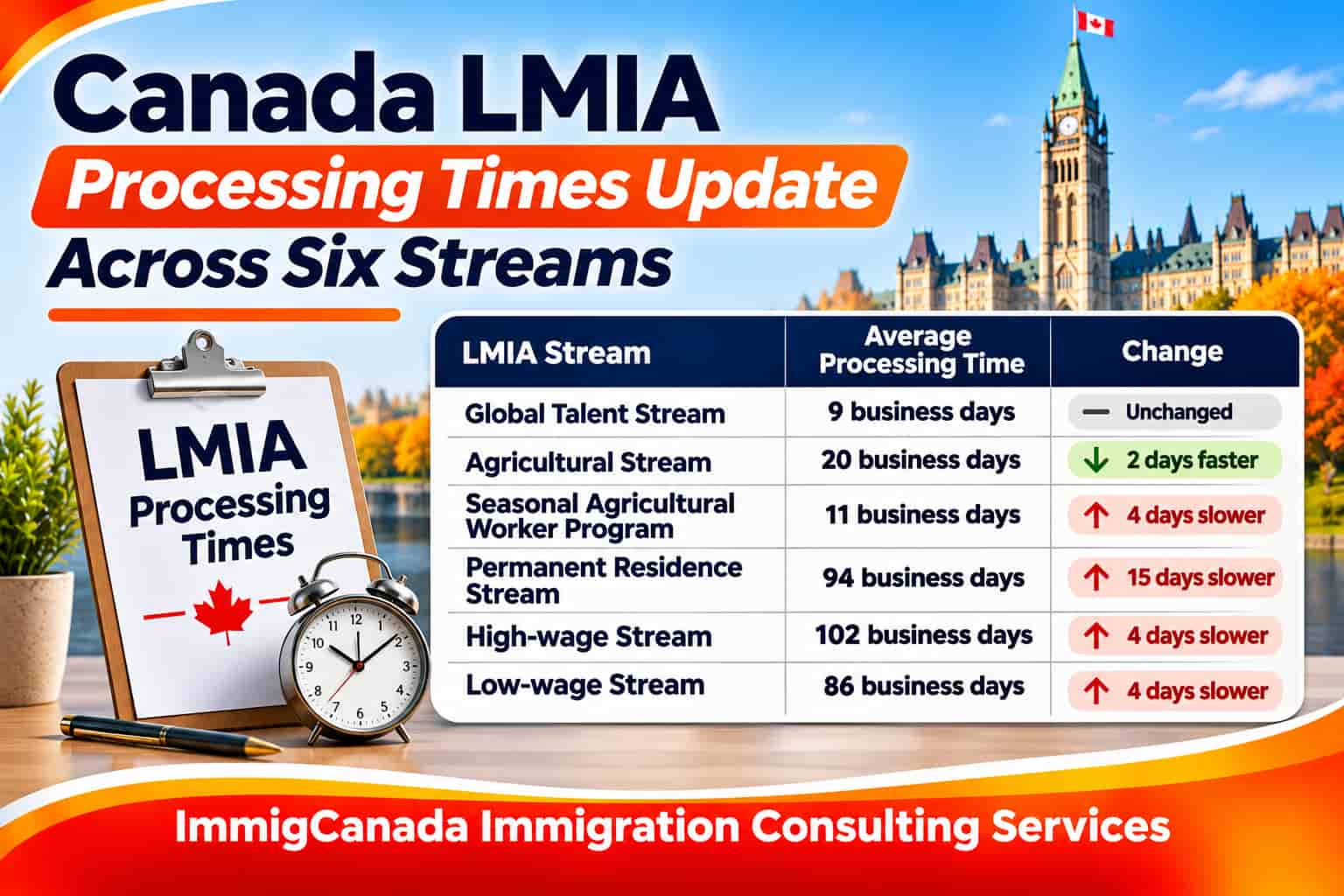

Employment and Social Development Canada (ESDC) has updated its LMIA processing times. The update came on November 12, 2026, and covers six streams. It is based on statistics from all processing centres. Four streams got slower. One got faster. One stayed the same.
The Latest Canada LMIA Processing Times
| Stream | Average processing time | Change |
| Global Talent Stream | 9 business days | Unchanged |
| Agricultural Stream | 20 business days | 2 days faster |
| Seasonal Agricultural Worker Program | 11 business days | 4 days slower |
| Permanent Residence Stream | 94 business days | 15 days slower |
| High-wage Stream | 102 business days | 4 days slower |
| Low-wage Stream | 86 business days | 4 days slower |
What Stands Out
The biggest jump is in the Permanent Residence Stream, up 15 business days to 94. That is a steep rise in one update.
The High-wage Stream now averages 102 business days. That is roughly 143 calendar days, or close to five months. The Low-wage Stream sits at 86 business days, about 120 calendar days.
On the bright side, the Global Talent Stream remains fast at 9 business days. The Agricultural Stream also improved slightly.
Source: Labour Market Impact Assessment application processing times
Why Speed Matters
An LMIA is often the first step in hiring a foreign worker. Until it is approved, an employer cannot move to the next step. A long wait can mean empty positions, missed contracts and stressed teams.
Workers feel the pressure too. Many have work permits that expire while an LMIA is pending. Delays can create real uncertainty for families.
Connection to Recent Rule Changes
These numbers explain recent policy moves. IRCC recently removed the 90 day holding limit for certain in-Canada work permit applications waiting on an LMIA decision. Longer processing times made the old limit hard to meet. ESDC has also announced that Low-wage Stream LMIAs submitted on or after November 6, 2026 can support employment for up to two years, up from one.
Taken together, these changes aim to reduce repeat filings and give employers more stability.
Remember that these are averages. Individual applications may be faster or slower. Complex cases, missing information or high demand in a region can all affect timing.
Employers should plan backward. Work out when you need the worker on the job. Subtract the processing time, then subtract extra weeks for work permit processing, medical exams and travel. File as early as the rules allow.
Quality matters as much as timing. Incomplete applications cause delays. Double check wages, job duties, recruitment efforts and supporting documents. Make sure job ads and records meet program requirements.
Workers with expiring permits should speak with their employers right away. Understand whether concurrent processing may apply. Keep copies of everything filed. If you are on maintained status, understand its conditions.
Consider your options. If you qualify for the Global Talent Stream, it offers speed. Other employers may be able to use provincial programs, open work permit categories or other exemptions. Review those carefully before choosing a path.
Avoid anyone who promises to speed up an LMIA for a fee. Processing is handled only by ESDC.
Looking Ahead
ESDC updates processing times regularly. Watch for further changes as demand shifts and the government rolls out Temporary Foreign Worker Program reforms funded in Budget 2026.
Frequently Asked Questions about LMIA Processing Times
102 business days on average, up 4 days.
The Global Talent Stream at 9 business days, unchanged.
The Permanent Residence Stream, up 15 days to 94 business days.
Yes. The Agricultural Stream fell 2 days to 20 business days.
Want to stay ahead of every change? Follow ImmigCanada for the latest Canada immigration news, official updates and expert insights. Bookmark ImmigCanada, subscribe to our updates and check back often. Your Canadian journey deserves reliable information.