

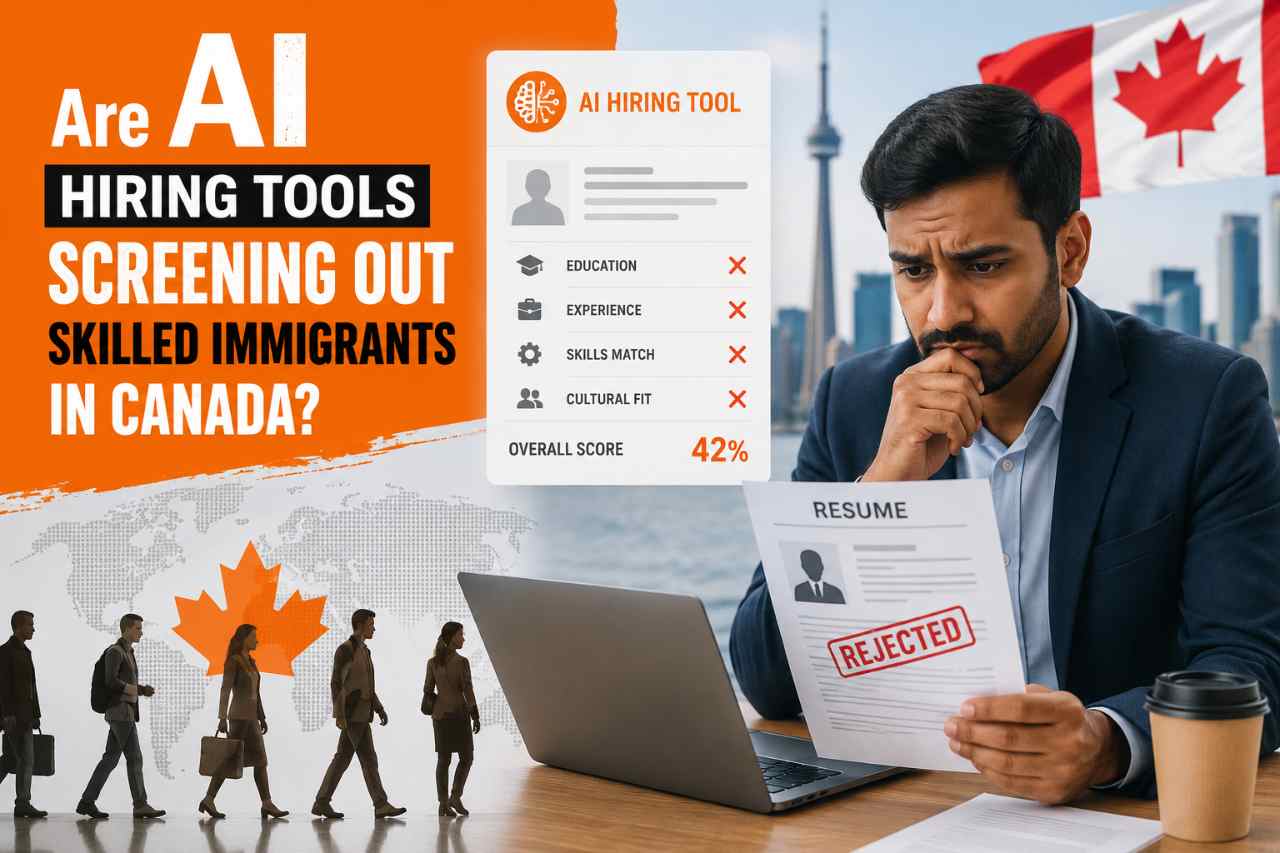

A Toronto Metropolitan University study finds that automated resume-screening tools may unfairly filter out skilled immigrant applicants before a human ever reviews their file. The algorithms often rely on historical hiring data that undervalues international credentials and overseas work experience, leaving many qualified newcomers underemployed despite driving most of Canada’s workforce growth.
Why are Skilled Immigrants Getting Filtered Out By Algorithms?
Canada depends on immigration to grow its labour force. That much is well established. What is less visible is what happens after newcomer hits submit on a job application. Many large employers now run applications through Advanced Digital Technologies, resume-screening software, automated keyword matching, and even AI-driven virtual interview platforms, before a human recruiter ever sees the file.
Researchers at Toronto Metropolitan University found that these systems frequently train on historical hiring data, meaning patterns from a company’s past successful hires. The trouble is, that historical data often reflects a narrower pool of candidates, typically those with domestic education and domestic-sounding job titles. International credentials, foreign employer names, and non-standard resume formats can confuse the algorithm rather than impress it, even when the underlying experience is perfectly strong.
What Does This Look Like For A Real Job Seeker?
Imagine a civil engineer with eight years of experience overseas, fluent English, and a Canadian credential assessment confirming equivalency. On paper, this is exactly the kind of candidate Canada’s immigration system was designed to attract. Yet that same candidate may submit dozens of applications and get zero callbacks, not because they lack qualifications, but because an automated screener flagged unfamiliar employer names or a resume format that does not match its training data.
Job seekers caught in this loop often respond by reverse-engineering their resumes, stuffing in keywords, renaming foreign job titles to approximate Canadian equivalents, and stripping out details that made their international background distinctive in the first place. That is a strange outcome for a system meant to evaluate merit.
What is The Research Actually Studying?
The Toronto Metropolitan University project looks at this issue from multiple angles rather than a single data point. It examines how Canadian employers are adopting Advanced Digital Technologies across recruitment, onboarding, and retention, weighing both the efficiency gains and the risk of reinforcing existing inequities. It also studies how immigrant jobseekers experience and navigate these digitally mediated hiring systems, and how digital career support tools might offset some of the disadvantage.
Key questions driving the research include how employers evaluate the fairness of their own hiring algorithms, what strategies immigrant jobseekers develop to work around automated systems, and whether digitally delivered career support actually improves employment outcomes for newcomers. The methodology blends interviews, surveys, thematic analysis, and statistical modelling, giving the findings real empirical weight rather than anecdote alone.
Should Canada Regulate Algorithmic Hiring Tools
Researchers and labour advocates studying this issue are increasingly calling for stronger oversight of black-box hiring technologies. The argument is straightforward: if these tools materially affect who gets hired, and there is evidence they disadvantage qualified immigrants, transparency and accountability standards make sense. Canada has already moved toward stronger algorithmic transparency requirements in other sectors, and labour market hiring may be the next frontier.
Until regulation catches up, the practical reality is that newcomers need to understand how these systems work well enough to get past them, not because that is fair, but because that is the current landscape.
What Can Skilled Immigrants Do Today To Improve Their Odds?
A few practical adjustments make a measurable difference. Match your resume language closely to the exact wording used in the job posting, since many screening tools weigh literal keyword overlap heavily. Get your international credentials formally assessed and reference that assessment directly on your resume. Where possible, translate foreign job titles into their closest Canadian NOC equivalent rather than leaving an unfamiliar title that an algorithm cannot parse. None of this should be necessary in a perfectly fair system, but it reflects the system as it currently operates.
Frequently Asked Questions
No, they are not illegal, but researchers and advocates are pushing for stronger regulation given evidence of unintended bias against immigrant applicants.
Many algorithms are trained on historical hiring data that reflects domestic education and employer patterns, making unfamiliar international formats harder for the system to evaluate accurately.
Adapting your resume to Canadian formatting conventions and matching job posting keywords can meaningfully improve callback rates while regulation catches up.
Automated screening is most common among larger employers with high application volumes, though adoption is spreading across company sizes.
Yes. Our settlement guidance includes resume coaching and labour market navigation alongside core immigration consultation services.
Struggling to get callbacks despite strong qualifications and a completed Canadian credential assessment? ImmigCanada’s settlement guidance team can help you navigate algorithm-first hiring systems. Book a consultation today to strengthen your job search strategy alongside your immigration journey.
Turning Algorithmic Barriers Into A Navigable Path
Skilled immigrants did not come to Canada to be filtered out by software before a human ever reads their resume, yet that is the reality many newcomers face today. RCIC Eivy Joy Quito and the ImmigCanada team believe a successful Canadian immigration journey does not end at landing, it continues through finding meaningful, credential-appropriate employment.
Our consultants combine immigration expertise with practical labour market guidance, helping clients understand not just how to qualify for Canada, but how to succeed once they arrive. If algorithmic hiring barriers are standing between you and the career you came to Canada to build, our team is ready to help you navigate the path forward.