

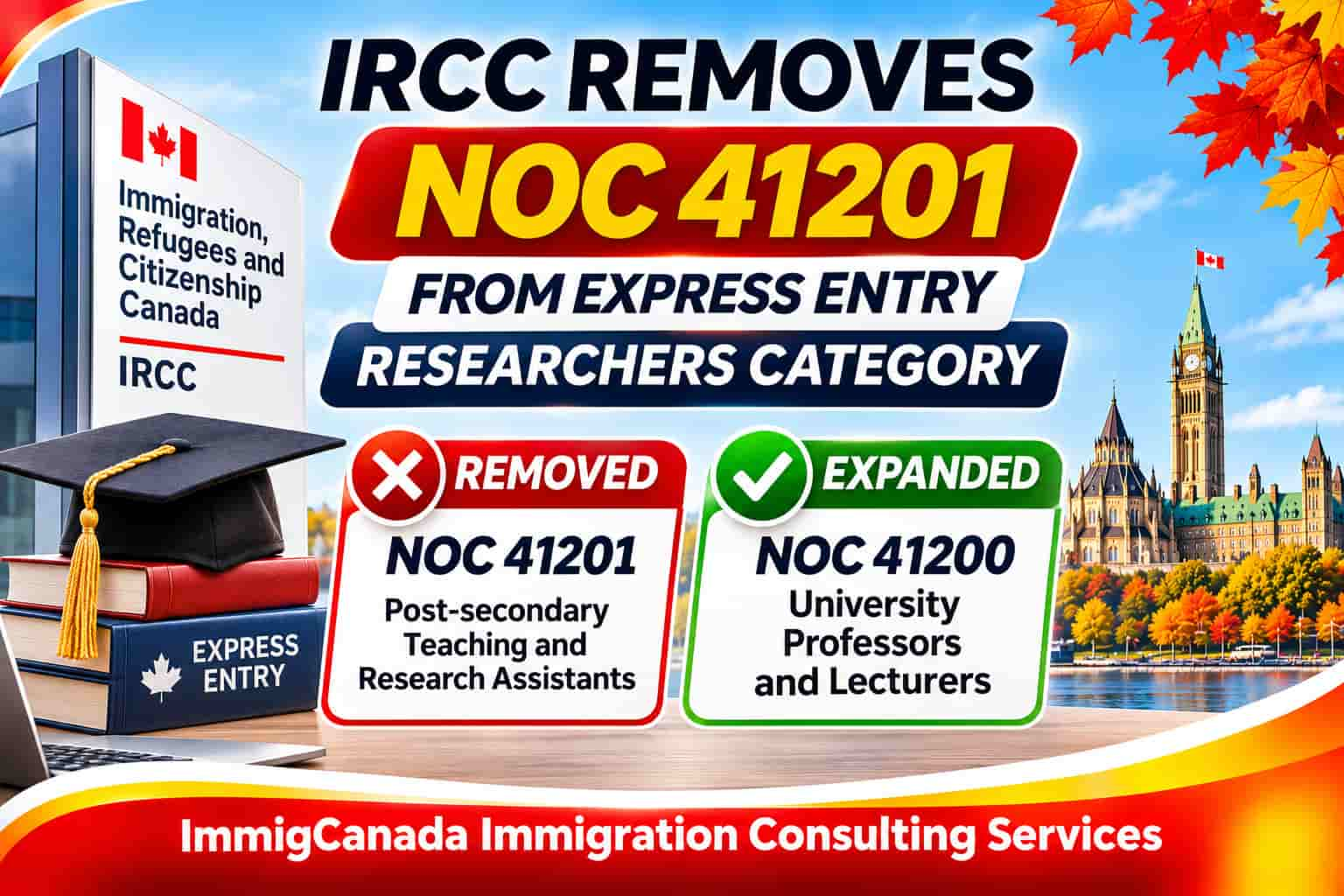

Immigration, Refugees and Citizenship Canada (IRCC) has announced changes to the Express Entry category for researchers with Canadian work experience, removing post-secondary teaching and research assistants from the category while expanding eligibility for university professors and lecturers. Announced on November 18, 2026, the changes took effect on November 17, 2026. Under the revised rules, candidates working as post-secondary teaching and research assistants under NOC 41201 are no longer eligible for selection through the researchers category.
At the same time, IRCC has expanded the eligibility criteria for university professors and lecturers under National Occupational Classification 41200. The revised rules recognize certain Canadian work experience and job offers compensated by Canadian entities through stipends, grants, bursaries or scholarships.
The changes could affect international academics, university researchers and Express Entry candidates who are counting on Canadian work experience to qualify for category-based selection or improve their Comprehensive Ranking System (CRS) scores.
IRCC is encouraging candidates with qualifying Canadian work experience to update their Express Entry profiles to reflect the revised eligibility rules.
What Has Changed in the Express Entry Researchers Category?
The latest IRCC announcement introduces two significant changes to the researchers category.
1. NOC 41201 removed from the category
Post-secondary teaching and research assistants under NOC 41201 are no longer eligible for selection under the Express Entry category for researchers with Canadian work experience.
2. Eligibility expanded for NOC 41200
University professors and lecturers under NOC 41200 can now benefit from expanded eligibility rules that recognize qualifying Canadian work experience and job offers compensated through certain financial arrangements provided by Canadian entities.
The changes are particularly relevant to academics whose compensation may not follow a conventional salary or payroll structure.
NOC 41201 Removed from Express Entry Researchers Category
Before the latest change, post-secondary teaching and research assistants under NOC 41201 were included in the researchers category.
However, effective November 17, 2026, IRCC has removed this occupation from the category.
This means candidates whose qualifying occupation falls under NOC 41201 can no longer rely on this category for an invitation through the researchers-focused selection rounds.
It is important to understand that removal from a specific Express Entry category does not automatically make an individual ineligible for Express Entry itself.
Candidates may still qualify through other available Express Entry programs, including the Canadian Experience Class or Federal Skilled Worker Program, provided they meet the respective eligibility requirements.
They may also remain eligible for other category-based selection opportunities if they satisfy the applicable criteria.
NOC 41200: IRCC Expands Eligibility for University Professors and Lecturers
One of the most important aspects of the November 2026 announcement is the expanded recognition of Canadian work experience and job offers for university professors and lecturers under NOC 41200.
Previously, certain academics working under non-traditional compensation arrangements could face difficulties demonstrating qualifying work experience or job offer eligibility.
The revised rules address this issue by recognizing qualifying compensation provided through:
- Stipends
- Research grants
- Bursaries
- Scholarships
Where the applicable requirements are satisfied, this compensation can now be recognized for relevant Express Entry purposes.
How Does This Affect Canadian Work Experience?
The updated eligibility rules allow qualifying Canadian work experience for NOC 41200 to count towards the work experience requirements of:
This is important for university professors and lecturers whose academic employment may involve research funding, institutional grants or scholarship-based compensation.
The change could allow eligible candidates to establish qualifying Canadian work experience even when their compensation structure differs from a conventional employment arrangement.
However, candidates must still satisfy the relevant program requirements, including applicable occupational duties, work experience duration, authorized work conditions and other eligibility criteria.
Can Stipends, Grants and Scholarships Help Candidates Earn CRS Points?
Yes, qualifying work experience and eligible job offers can also count towards Comprehensive Ranking System points under the revised rules.
The CRS is the points-based system used to rank eligible candidates in the Express Entry pool.
Candidates receive points based on several factors, including age, education, language proficiency, work experience and other applicable factors.
The revised recognition of qualifying compensation arrangements could help eligible university professors and lecturers receive credit for work experience or job offers that may previously have been difficult to recognize under the relevant Express Entry criteria.
However, the change does not mean that every grant, scholarship or stipend automatically qualifies. The work experience and job offer must satisfy the applicable IRCC requirements.
What Is NOC 41200 and NOC 41201?
The National Occupational Classification system is used by the Canadian government to classify occupations based on their job duties and responsibilities.
The two occupations affected by the latest announcement are:
| NOC code | Occupation | Latest Express Entry category position |
| 41200 | University professors and lecturers | Remains eligible, with expanded recognition rules |
| 41201 | Post-secondary teaching and research assistants | Removed from the researchers category |
Candidates should select their NOC based on their actual job duties rather than relying exclusively on their job title.
A correct NOC classification is important because IRCC assesses work experience against the occupational description and its main duties.
What Should Express Entry Candidates Do After the Changes?
IRCC has encouraged candidates with qualifying Canadian work experience to update their Express Entry profiles.
Candidates affected by the revised rules should consider the following steps:
1. Review your NOC classification
University professors and lecturers should confirm whether their employment corresponds to NOC 41200.
2. Review your compensation structure
Candidates receiving stipends, research grants, bursaries or scholarships should assess whether their compensation arrangement meets the revised requirements.
3. Check your Canadian work experience
Review the duration, nature and supporting evidence of your Canadian employment to determine whether it satisfies the applicable CEC or FSWP requirements.
4. Reassess your CRS score
Eligible work experience and job offers may affect your CRS points. Candidates should review their profiles to determine whether the revised rules change their ranking.
5. Update your Express Entry profile
Where applicable, update your profile with accurate information reflecting your qualifying work experience and compensation arrangements.
Candidates should ensure that all information is accurate and supported by appropriate documentation.
How Could These Changes Affect Canada’s Research and Academic Talent Pool?
The latest changes reflect IRCC’s evolving approach to recognizing academic work arrangements within Canada’s economic immigration system.
Universities and research institutions often rely on different funding structures to compensate academics and researchers. Some positions may involve traditional salaries, while others may include stipends, grants or scholarship-based funding.
By recognizing certain alternative compensation arrangements for NOC 41200, IRCC has expanded the potential pool of university professors and lecturers who can receive credit for qualifying Canadian work experience and eligible job offers.
At the same time, removing NOC 41201 narrows the occupations eligible under this particular category.
For international academics, the practical impact will depend on their occupational classification, employment arrangement and eligibility under the relevant Express Entry program.
Frequently Asked Questions
IRCC removed NOC 41201, covering post-secondary teaching and research assistants, from the researchers category and expanded eligibility for university professors and lecturers under NOC 41200.
The revised rules took effect on November 17, 2026, and were announced by IRCC on November 18, 2026.
NOC 41201 is no longer eligible for selection under the researchers category. However, individuals in this occupation may still qualify for other Express Entry programs or categories if they meet the applicable requirements.
Yes. University professors and lecturers under NOC 41200 remain eligible, subject to the applicable category requirements. IRCC has also expanded the recognition of qualifying work experience and job offers involving certain alternative compensation arrangements.
Qualifying Canadian work experience compensated through eligible arrangements involving research grants may now be recognized under the revised rules, provided all applicable IRCC requirements are met.
They may qualify under the revised rules for NOC 41200. However, receiving a stipend or scholarship alone does not establish qualifying work experience. The employment and compensation arrangement must satisfy the applicable requirements.
Qualifying Canadian work experience and eligible job offers under the revised rules can count towards relevant CRS points. The candidate must still satisfy the applicable requirements.
No. The removal applies to eligibility under the researchers category. Research assistants may still qualify through other immigration programs if they meet the relevant criteria.
Eligible university professors and lecturers may use qualifying Canadian work experience towards the CEC requirements, provided they satisfy the applicable eligibility criteria.
Yes. Qualifying work experience may count towards the FSWP work experience requirements under the revised rules, subject to all other program conditions.
IRCC encourages candidates with qualifying Canadian work experience to update their profiles. Candidates should first verify that their employment and compensation arrangements meet the revised criteria.
No. A CRS increase is not automatic. Any change depends on the candidate’s qualifying work experience, eligible job offer and other applicable CRS factors.
Are You an International Academic Planning to Apply for Canada PR?
Changes to Express Entry eligibility can create new opportunities for some candidates while affecting the options available to others. Understanding your NOC classification, Canadian work experience and CRS eligibility is essential before updating your profile or submitting an application.
At ImmigCanada, RCIC Eivy Joy Quito can help you assess your Express Entry eligibility, understand the latest IRCC category-based selection changes and determine how your Canadian academic or research experience may affect your permanent residence options.
Whether you are a university professor, lecturer or researcher, get in touch with ImmigCanada to explore your Canadian immigration options and make informed decisions about your PR journey.