

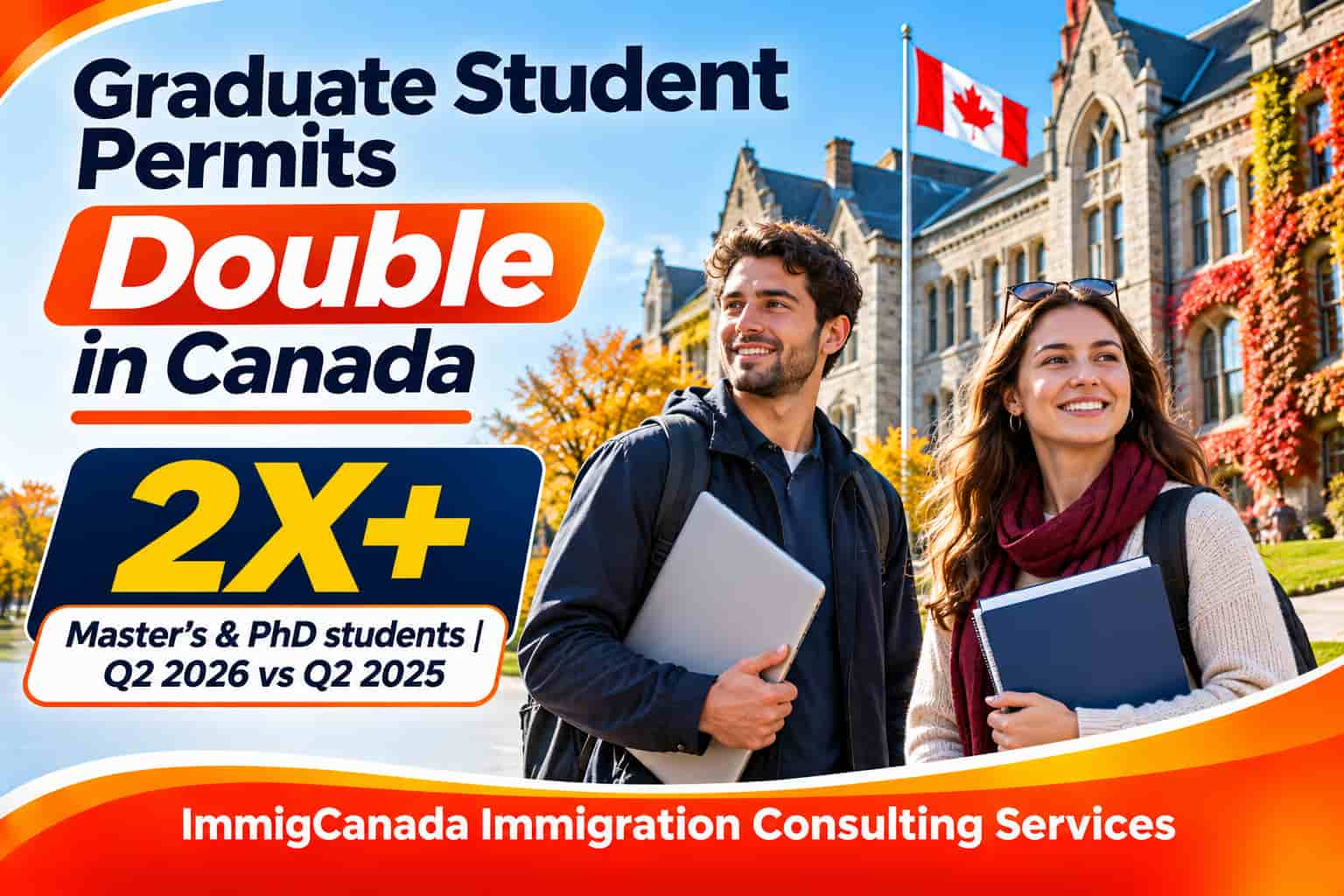

Canada’s international education landscape is showing a notable shift towards postgraduate recruitment. New study permits issued to international master’s and doctoral students more than doubled in the second quarter of 2026 compared with the same period in 2025, even as the overall number of applications declined.
The figures come as universities, colleges and education-sector organizations assess the federal government’s latest immigration targets. Under Canada’s 2027–2029 Immigration Levels Plan, the government intends to welcome 150,000 new international student arrivals annually over the three-year period.
The developments suggest that Canada is seeking to maintain a more targeted international student intake, with graduate-level education playing an increasingly important role.
Graduate study permits more than doubled in Q2 2026
Data reported by University Affairs shows that IRCC issued 6,455 new study permits to international graduate students between April and June 2026. This was more than double the 3,085 permits issued in the same quarter of 2025.
The increase was also visible in extensions of existing graduate study permits. These rose from 3,935 in Q2 2025 to 8,035 in Q2 2026.
The rise occurred despite a decrease in the number of graduate students seeking new or extended permits. Applications in this category totalled 23,480 in the second quarter of 2026, compared with 26,820 in the corresponding period of 2025.
Graduate students accounted for approximately 20% of new study permits issued between January and August 2026, compared with 12% in 2025, according to the information provided in the report.
These figures point to a stronger share of graduate-level students in Canada’s study permit intake. However, they should not be interpreted as a guarantee that individual applicants will receive approval.
Why are master’s and PhD students receiving greater attention?
Canada has adjusted its international student policies in recent years to manage the volume of temporary residents while continuing to attract talent considered important to its economy and research institutions.
One significant policy change took effect in January 2026, when eligible master’s and doctoral students at public designated learning institutions became exempt from the study permit cap and the associated provincial or territorial attestation letter requirement.
This exemption has made the application process different for eligible postgraduate students compared with many other international student applicants. It does not remove the requirement to obtain a study permit or satisfy the other applicable immigration conditions.
Graduate recruitment is also relevant to Canada’s research and innovation priorities. Universities rely on international postgraduate students to support advanced research, teaching, specialist skills development and collaboration across academic institutions.
For students considering postgraduate education, the policy environment may offer a different application framework from the one applicable to many undergraduate and college programs.

Canada sets annual international student targets of 150,000 through 2029
The 2027-2029 Immigration Levels Plan sets a target of 150,000 new international student arrivals for each of the three years.
The plan also sets a target of 220,000 new temporary worker arrivals annually, bringing the overall planned temporary resident arrivals to 370,000 per year.
These figures reflect the government’s intention to manage temporary resident numbers while continuing to attract students and workers who can contribute to Canada’s economy.
It is important to understand what the target represents. It is a planning figure for new arrivals, not a promise that every eligible applicant will receive a study permit. Actual approvals depend on individual applications, program requirements, available capacity and immigration policy.
The targets also do not mean that all study permit categories will experience the same level of demand or approval.
How have Canadian education organizations responded?
The latest immigration plan has received a generally positive response from parts of Canada’s university sector, particularly because the student arrival targets remain stable through 2029.
Universities Canada and the Canadian Bureau for International Education have welcomed the predictability offered by the multi-year targets. Stable planning figures can help institutions prepare recruitment strategies, manage enrolment and make decisions about academic programs and student support.
However, the education sector has also highlighted the difference between announced targets and actual student arrivals. The Canadian Bureau for International Education has pointed to the lower-than-expected number of new international student arrivals during 2026.
Colleges and Institutes Canada has also called for public college graduates and skilled tradespeople to be included in future talent attraction and retention strategies.
This response reflects a broader policy question: how can Canada attract international talent while ensuring that education pathways remain connected to workforce needs and long-term economic priorities?
What should international students consider before applying?
The increase in graduate permits may be encouraging for prospective master’s and PhD students, but choosing a Canadian program requires more than looking at recent approval numbers.
Applicants should consider the following:
1. Confirm the institution’s eligibility
Check that the institution is a designated learning institution (DLI) and that the intended program meets the applicable study permit requirements.
2. Understand the PAL/TAL rules
Eligible master’s and doctoral students at public DLIs are exempt from the provincial or territorial attestation letter requirement under the rules effective January 2026. Other applicants may still need a PAL or TAL, depending on their circumstances and applicable exemptions.
3. Prepare sufficient financial documentation
Applicants must demonstrate that they can cover tuition, living expenses and other required costs. Financial requirements should be checked against the latest IRCC instructions.
4. Choose a program that supports clear academic and career goals
The selected course should make sense in light of the applicant’s previous education, professional experience and future plans.
5. Understand that a study permit is temporary status
Completing a Canadian degree does not automatically lead to permanent residence or a post-graduation work permit. Eligibility for a work permit and any later immigration pathway must be assessed separately.
What does this mean for Canada’s international education sector?
The increase in graduate study permits indicates that postgraduate students are becoming a more prominent part of Canada’s international education intake. The stable 150,000 annual targets through 2029 also give institutions a planning framework, although the actual number of new arrivals may differ from the target.
For prospective students, the main consideration is whether a Canadian program is academically and financially suitable and whether they can satisfy the current study permit requirements.
A postgraduate qualification may support future career opportunities, but it should not be viewed as an automatic route to employment or permanent residence. Applicants should review official IRCC guidance and assess each stage of their plans independently.
ImmigCanada offers information and guidance on Canadian study permit requirements and immigration pathways. A careful review of the institution, program, finances and long-term objectives can help students make informed decisions before applying.
Frequently Asked Questions
Canada issued 6,455 new study permits to international graduate students in April, May and June 2026, compared with 3,085 in the same quarter of 2025.
Eligible master’s and doctoral students at public designated learning institutions are exempt from the study permit cap and PAL/TAL requirement under the rules effective January 2026. Other study permit requirements still apply.
The federal government has set a target of 150,000 new international student arrivals for 2027, with the same annual target planned for 2028 and 2029.
No. It is a government planning target for new arrivals, not a guarantee of approval for individual applicants.
No. Graduates must qualify under a separate permanent residence pathway and meet its requirements. A Canadian degree alone does not guarantee permanent residence.
No. Eligible master’s and doctoral students at public DLIs are exempt under the rules effective January 2026. Other applicants should check the current IRCC requirements and applicable exemptions.