

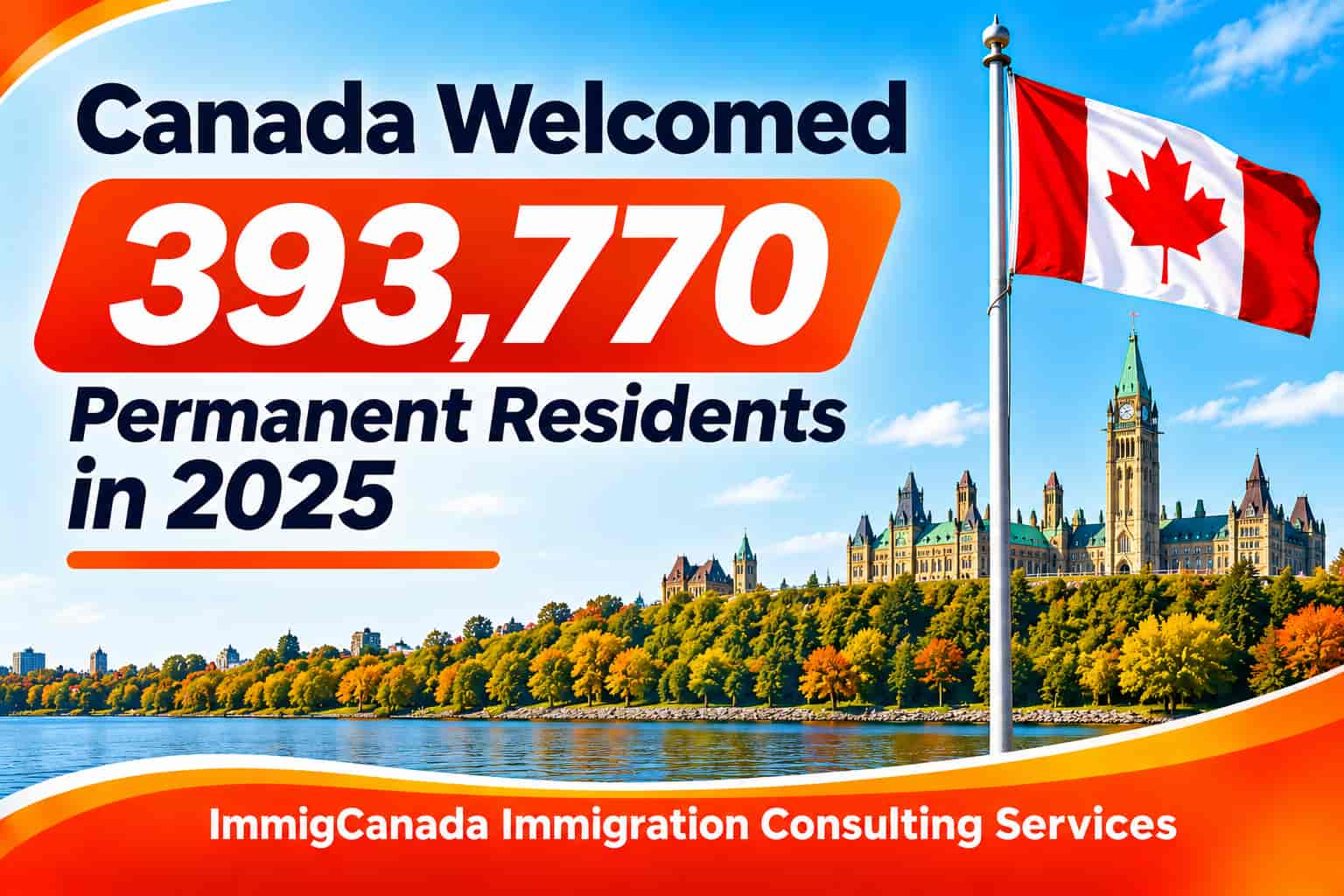

Canada admitted 393,770 permanent residents in 2025, an 18.6% decrease from the 483,640 admissions recorded in 2024. The figures appear in Immigration, Refugees and Citizenship Canada’s (IRCC) 2026 Annual Report to Parliament on Immigration, which provides a detailed picture of Canada’s immigration trends and selection priorities.
Despite the decline in overall admissions, economic immigration remained the largest category, accounting for 57.3% of all new permanent residents. The report also highlights the continued importance of Provincial Nominee Programs (PNPs), Express Entry, regional immigration and the transition of temporary residents to permanent status.
These figures offer useful context for prospective immigrants assessing Canada’s current and future immigration priorities.
Economic immigration accounted for more than half of admissions
Of the 393,770 permanent residents admitted in 2025, 225,680 arrived through economic immigration programs. This represented 57.3% of total admissions, although the category recorded a decline compared with 2024.
Two major pathways accounted for a substantial share of economic admissions:
- Provincial Nominee Programs: 85,120 admissions.
- Federal High Skilled programs: 79,730 admissions.
The Federal High Skilled category includes the Federal Skilled Worker Program, Canadian Experience Class and Federal Skilled Trades Program.
These figures demonstrate the continuing role of skilled worker selection in Canada’s immigration system. Candidates can explore the Express Entry system and Provincial Nominee Program pathways to understand how federal and provincial selection routes differ.
Source: 2026 Annual Report to Parliament on Immigration
Express Entry remained a major route to permanent residence
IRCC reported that 114,930 people obtained permanent residence through Express Entry in 2025. This figure includes principal applicants and accompanying family members, as well as candidates nominated through Express Entry-aligned provincial streams.
Express Entry manages applications under three federal economic immigration programs: the Federal Skilled Worker Program, the Canadian Experience Class and the Federal Skilled Trades Program. It also supports a portion of PNP applications.
The system’s category-based selection approach allows IRCC to invite eligible candidates based on specific economic and labour market priorities. In 2025, invitations included candidates with French-language proficiency and experience in areas such as healthcare and social services, trades and education.
For applicants, this means that immigration planning should consider more than the Comprehensive Ranking System (CRS) score alone. Program eligibility, occupational experience, language results, provincial opportunities and changing selection priorities can all influence the available options.
India remained the leading source country for economic immigrants
India continued to be Canada’s largest source country for economic immigration in 2025, accounting for 68,085 admissions, or approximately 30.2% of the economic category.
Other leading source countries included Cameroon, the Philippines, Nigeria and France. The report also noted a larger contribution from several African countries, reflecting, in part, the role of French-language selection and targeted occupational priorities.
These figures describe the citizenship of admitted permanent residents, not necessarily the country where they were living when they applied. They also do not mean that applicants from a particular country receive preferential treatment across every immigration program.
Francophone immigration outside Quebec exceeded its target
Canada admitted 29,630 French-speaking permanent residents outside Quebec in 2025. This represented 8.9% of all permanent residents admitted outside the province, exceeding the federal target of 8.5%.
The result reflects the growing importance of Francophone immigration in supporting French-speaking communities outside Quebec. Canada’s 2027-2029 Immigration Levels Plan sets progressively higher targets for French-speaking permanent resident admissions outside Quebec: 9.5% in 2027, 10.5% in 2028 and 12% in 2029.
For French-speaking applicants, this policy direction makes it worthwhile to assess language ability as part of an overall immigration strategy. Eligible candidates may wish to explore Express Entry’s French-language category and relevant provincial pathways.
Most newcomers settled in four provinces
The report also highlights the geographic concentration of permanent resident admissions. Approximately 84% of newcomers were destined for Ontario, Quebec, Alberta and British Columbia.
While these provinces continue to attract a large share of newcomers, regional immigration remains an important part of Canada’s strategy. Provincial programs allow participating provinces and territories to select candidates according to their labour market and demographic needs.
Applicants should therefore consider employment opportunities, provincial eligibility requirements and their genuine intention to settle in a particular location rather than focusing only on the most popular destinations.
Nearly 170,000 former temporary residents became permanent residents
Another important finding concerns the transition from temporary to permanent status. In 2025, approximately 145,735 former work permit holders and 20,790 former international students became permanent residents, representing nearly 166,500 people combined.
This supports Canada’s policy direction of retaining eligible people who are already studying or working in the country. However, holding a study permit or work permit does not automatically lead to permanent residence. Applicants must still qualify under an available immigration program and meet its requirements.
What the 2025 immigration figures mean for applicants
The 2026 Annual Report shows that Canada is maintaining a strong economic focus while adjusting the overall pace and composition of immigration. The 2027–2029 Immigration Levels Plan sets annual permanent resident admissions at 380,000, with economic immigration representing a larger planned share.
For prospective immigrants, the key takeaway is to assess eligibility across suitable federal and provincial pathways rather than relying on past admission numbers as a prediction of future selection.
ImmigCanada provides guidance on Express Entry and Provincial Nominee Programs, helping candidates assess their qualifications and identify immigration options that may fit their circumstances. Applicants should always confirm current requirements through official IRCC and provincial government sources.
Frequently Asked Questions
Canada admitted 393,770 permanent residents in 2025, an 18.6% decrease compared with 2024.
Economic immigration was the largest category, with 225,680 admissions, representing 57.3% of the total.
IRCC reported 114,930 admissions through Express Entry, including principal applicants and accompanying family members.
India was the leading source country, with 68,085 economic immigration admissions.
Canada admitted 29,630 French-speaking permanent residents outside Quebec, representing 8.9% of admissions in those regions.
No. Temporary residents must qualify under an available permanent residence pathway and satisfy its eligibility and application requirements.